

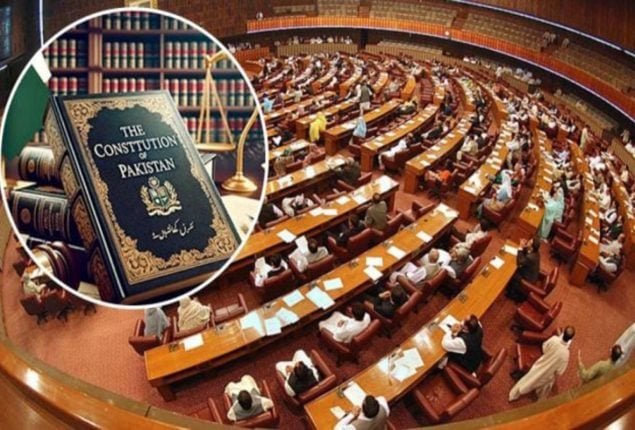

The 27th Amendment to Pakistan’s Constitution has made significant headway, with a broad consensus emerging on key proposals. Members of the joint parliamentary committee have approved amendments to Article 233, granting the president constitutional immunity in principle. However, clarification on whether this immunity will be applied retrospectively is still pending.
The committee has also approved amendments to Article 200, providing the president authority to transfer High Court judges on the recommendation of the Judicial Commission. Notably, Chief Justices of High Courts will remain exempt from transfers, and transferred judges will not outrank the Chief Justice of the new court.
Financial and Local Government Amendments
Agreement has been reached on proposals submitted by the Muttahida Qaumi Movement (MQM) regarding financial allocations to local government representatives. Coalition parties introduced three additional amendments, reflecting collaborative efforts to strengthen governance structures.
One proposal under discussion involves renaming Khyber Pakhtunkhwa to Pakhtunkhwa. However, many committee members recommended deferring this decision to maintain broader consensus.
Judicial, Electoral, and Advisory Reforms
The 27th Amendment includes establishing a Federal Constitutional Court and implementing electoral reforms related to Senate elections. Additionally, a proposal has been added to authorise the Prime Minister to appoint seven advisers, with an increase in the number of advisers for provincial chief ministers.
The deletion of Articles 184, 186, and 191-A from the Constitution has also been suggested. Committee Chairman Farooq H. Naek confirmed that consultations will continue until complete agreement is reached among all parties.
Political Cooperation and Challenges
Minister of State for Interior Talal Chaudhry stated that broad agreement has been achieved on many issues, emphasizing that no amendment will be blocked through coercion. He noted that the Pakistan Tehreek-e-Insaf (PTI) intends to distance itself from parliamentary proceedings.
Under constitutional provisions, a two-thirds majority is required in both Houses to pass a constitutional amendment. Currently, 64 votes are needed in the Senate and 224 in the National Assembly. The opposition, holding 30 Senate seats, is expected to oppose the amendment.
Prime Minister’s Efforts for Consensus
Prime Minister Shehbaz Sharif has taken proactive steps to secure passage of the 27th Amendment. He invited allied party senators to a dinner meeting, highlighting that the amendment was prepared in the national interest to strengthen federal-provincial relations.
Sharif praised the cooperation of all allied parties, including the Pakistan Peoples Party (PPP), Muttahida Qaumi Movement-Pakistan (MQM-P), and Istehkam-e-Pakistan Party (IPP). He emphasized that their collaborative efforts are crucial to ensuring smooth approval of the amendment.
The 27th Amendment marks a significant step toward constitutional reform in Pakistan, focusing on presidential immunity, judicial transfers, electoral changes, and advisory enhancements. Continued consultations aim to secure consensus, ensuring reforms align with national and provincial interests.
