

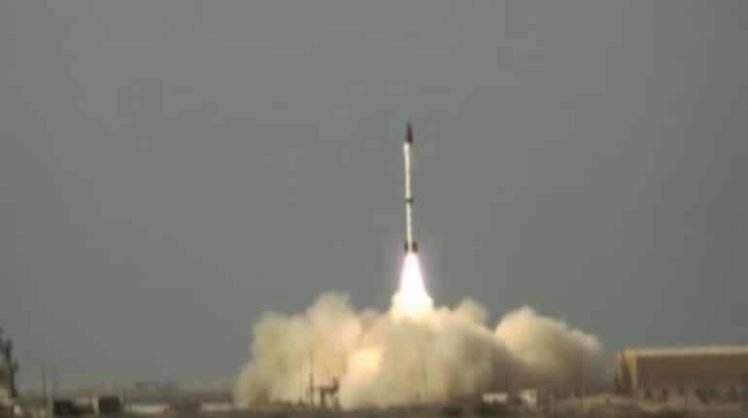

France, Germany, Italy, and Poland have signed a letter of intent to develop ground-launched cruise missiles with a range exceeding 500 km (310 miles). This initiative aims to address gaps in European arsenals highlighted by Russia’s war in Ukraine.
French Defence Minister Sebastien Lecornu, speaking at the NATO summit in Washington following the signing ceremony on Thursday, stated that the new missile is intended to serve as a deterrent. He mentioned the potential for broader participation, including from Britain’s new Labour government, noting that wider involvement could help distribute costs.
Lecornu indicated that a preliminary draft of the missile could be ready by the end of the year, with detailed specifications such as range to be finalized later.
His comments came a day after Washington and Berlin announced plans to deploy US long-range missiles, including the SM-6, Tomahawks, and developmental hypersonic weapons, on German soil starting in 2026. Moscow condemned this deployment as a “very serious threat” to Russian national security, viewing it as a temporary measure until Europe develops its own long-range missiles.
Since Russia’s invasion of Ukraine in 2022, cruise missiles with ranges of several hundred kilometers have seen increased use, with Moscow launching cross-border strikes and Kiev retaliating against targets within Russia.
Currently, Europe’s stockpile of cruise missiles includes air-launched weapons such as Britain’s Storm Shadow, France’s Scalp, and Germany’s Taurus, all with ranges around 500 km.
A military source stated that the new ground-based missile aims for a range of 1,000 to 2,000 km to meet NATO’s needs. Paris has proposed basing the missile on a modified version of its existing naval cruise missile MdCN, produced by European defense company MBDA, which also makes the Taurus, Storm Shadow, and Scalp.
MBDA, owned by Franco-German Airbus, British BAE Systems, and Italian Leonardo, is working on adapting the MdCN for launch from truck-mounted rocket launchers.
Developing a missile with a range over 500 km effectively reintroduces a category of weapons banned under the Intermediate-Range Nuclear Forces (INF) Treaty until 2019. The INF Treaty, signed in 1987, prohibited nuclear and conventional ground-launched missiles with ranges between 500 and 5,500 km, eliminating an entire class of weapons.
In the 1990s, Germany, Hungary, Poland, and the Czech Republic, followed later by Slovakia and Bulgaria, destroyed their missiles in compliance with the INF Treaty.
