

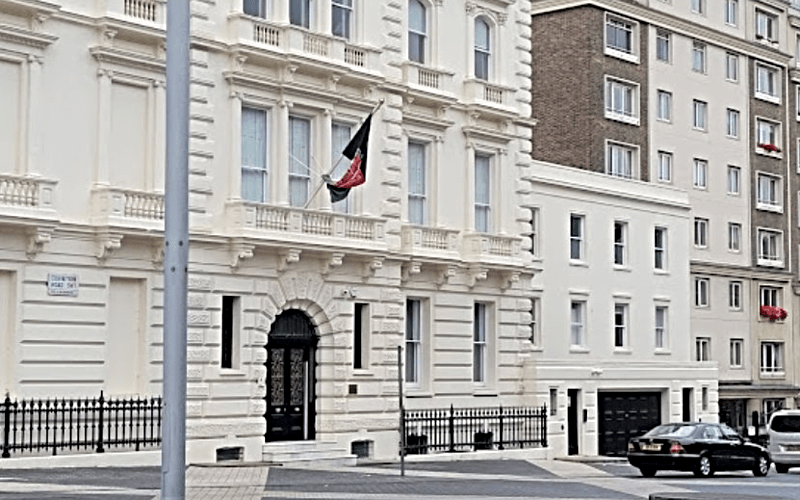

The Afghan embassy in London is set to close on September 27, as confirmed by Ambassador Zalmai Rassoul on Monday. The decision comes in response to requirements from UK authorities, as announced on the social media platform X.
The closure takes place amid ongoing disputes over the control of Afghan embassies in Western nations. Previously, the Taliban’s Ministry of Foreign Affairs had sent letters to 13 countries, including those in Europe, Canada, and Australia, declaring that consular services provided by embassies run by diplomats from the former Afghan government were invalid without Taliban oversight.
Experts point out that Afghanistan’s lack of an internationally recognized government has created major challenges for its diplomatic missions and Afghan citizens living abroad.
Legal expert Ghulam Farooq Aleem remarked that, ideally, these embassies would continue to function, but the absence of a legitimate government in Afghanistan has left no legal framework for their operations. As a result, countries such as the United States and the UK have opted to shut down Afghan diplomatic missions, leaving Afghan citizens to face the consequences.
In Europe, a diplomatic source revealed that Germany has urged the Afghan embassy in Berlin to engage with the Taliban to resolve the issue. So far, Germany is the only country to formally respond to the Taliban’s letter.
A protest outside the German Foreign Ministry in Berlin saw Afghan citizens opposing any diplomatic engagement with the Taliban, emphasizing concerns over human rights. Meanwhile, some countries have advised diplomats from the previous Afghan government to ignore the Taliban’s letters, according to another diplomatic source.
Last month, the Taliban’s Ministry of Foreign Affairs stated that only consular services from five Afghan embassies—in Germany, the Netherlands, Spain, Bulgaria, and the Czech Republic—would be recognized by the Taliban. European nations are expected to convene a special meeting on September 28 to decide the future of Afghan embassies across the continent.
Afghan citizens hope that any engagement with the Taliban will prioritize human rights issues.
