

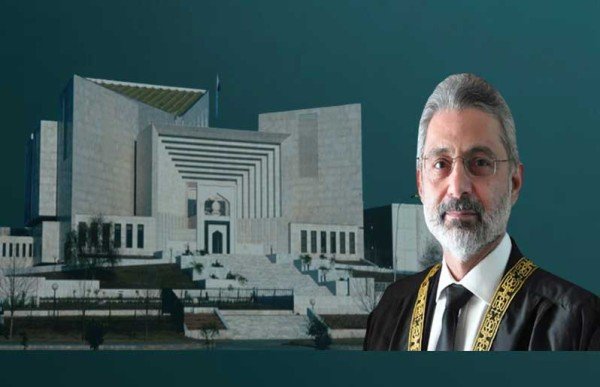

ISLAMABAD: The Supreme Court on Wednesday dismissed the Pakistan Tehreek-e-Insaf’s (PTI) objection to the composition of the bench hearing the review petition on the Article 63(A) verdict and instructed the federal government to arrange a meeting between imprisoned former Prime Minister Imran Khan and the party’s lawyer, Ali Zafar.
“Arrangements should be made for a meeting between Barrister Ali Zafar and the PTI founder,” directed Chief Justice of Pakistan (CJP) Qazi Faez Isa, telling the attorney general to ensure the meeting happens by tonight.
This development comes as a five-member bench, led by CJP Isa and comprising Justice Amin-ud-Din Khan, Justice Jamal Khan Mandokhail, Justice Mazhar Alam Khan Miankhel, and Justice Naeem Akhtar Afghan, continues to hear the Supreme Court Bar Association’s (SCBA) petition challenging the Supreme Court’s previous ruling on the defection clause. The bench was reconstituted a day earlier after Justice Munib Akhtar became “unavailable” for various reasons.
The SCBA had filed the petition in opposition to the court’s May 2022 ruling, which declared that the votes of dissident members of Parliament, cast against their party’s directives, could not be counted.
During Tuesday’s hearing, both the federal government and the Pakistan Peoples Party (PPP) supported the SCBA’s review petition, while PTI opposed it.
SCBA President Shahzad Shaukat argued that the 2022 verdict attempted to “rewrite the Constitution,” while the additional attorney general informed the court that the ruling did not call for the immediate disqualification of a lawmaker if they voted against party lines.
Background Info of the Case
This issue originated from a reference submitted by the PTI government in 2022, seeking the Supreme Court’s interpretation of Article 63(A) to address political defections and ensure the integrity of the electoral process.
In a 3-2 decision, the court ruled against defections, prohibiting lawmakers from voting against their party’s policies in Parliament. Then-Chief Justice Umar Ata Bandial, along with Justices Ijazul Ahsan and Munib Akhtar, voted in favor of the ruling, while Justices Jamal Khan Mandokhail and Mazhar Alam Khan Miankhel dissented.
The SCBA petitioned the Supreme Court to review its interpretation of the May 2022 ruling, specifically its decision not to count dissident votes. The SCBA argued that while dissident members should be disqualified, their votes must still be counted in accordance with the Constitution.
“The Supreme Court’s decision to disregard dissident votes is unconstitutional and constitutes interference with the Constitution,” the SCBA stated in its plea.
Understanding Article 63(A)
Article 63(A) of the Constitution of Pakistan addresses the disqualification of parliamentarians on the grounds of defection. A lawmaker can be disqualified if they vote or abstain from voting in the House contrary to their party’s directives. However, this applies only in three situations:
- Election of the prime minister or chief minister;
- Vote of confidence or no-confidence;
- Money bill or a constitutional amendment bill.
Before declaring defection, the party leader must give the concerned lawmaker a chance to explain their actions. If the party head decides to proceed, a written declaration is sent to the speaker, who then forwards it to the chief election commissioner (CEC). The CEC has 30 days to confirm the defection, after which the lawmaker’s seat becomes vacant.
