

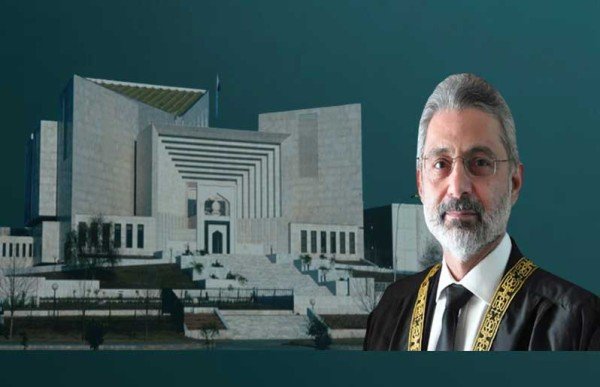

ISLAMABAD: The Supreme Court of Pakistan unanimously overturned a previous ruling regarding the defection clause under Article 63-A of the Constitution.
A newly formed five-member bench, led by Chief Justice of Pakistan Qazi Faez Isa and including Justices Ameenuddin, Jamal Khan Mandokhel, Mazhar Alam Miankhel, and Naeem Afghan, delivered the short verdict. This new bench was constituted after Justice Munib Akhtar recused himself from the proceedings. The court accepted a review petition challenging the interpretation of Article 63-A. Chief Justice Isa announced that the detailed verdict would be shared later.
Earlier in the day, Barrister Ali Zafar, representing Imran Khan, boycotted the Supreme Court’s hearing of the review petition. As the hearing commenced, Chief Justice Isa asked Zafar if he would object to being appointed as amicus curiae (a friend of the court). Zafar replied that he had no objection to the court’s decision but raised concerns about the composition of the bench, stating that Imran Khan had instructed him not to proceed with the case before this particular bench.
Chief Justice Isa reminded Zafar, as a senior lawyer and former president of the bar, that he is an officer of the court and should avoid such comments. A heated exchange followed, with Zafar insisting he would not proceed unless the PTI founder was permitted to speak. Zafar also expressed concerns that constitutional amendments by the government could lead to the verdict enabling horse-trading in the future. Chief Justice Isa warned Zafar against making strong statements, reminding him to maintain mutual respect as a senior officer of the court.
Zafar argued that the previous decision under Article 63-A had restricted horse trading, but the current review could undo those protections. The Chief Justice urged that there was no need to fear a single decision and emphasized the importance of allowing the country to move forward.
The day before, tensions flared in court when Mustafin Kazmi, a PTI representative, was ordered to leave by the Chief Justice after a verbal clash.
Background on the SCBA Review Petition
In 2022, the Supreme Court Bar Association (SCBA) filed a petition seeking a review of the Supreme Court’s opinion in the Presidential Reference regarding the interpretation of Article 63-A. The SCBA argued that the court’s ruling, which barred the counting of votes from defecting members, was against the spirit of the Constitution. The Bar petitioned for the court to reverse this decision, emphasizing that defecting members should only be de-seated under the Constitution.
The federal government and the Election Commission of Pakistan were made parties to the case. In a previous split decision (3-2) delivered on May 17 by a five-member bench led by then Chief Justice Umar Ata Bandial, the court had ruled that defecting members’ votes would not be counted, with the Chief Justice asserting that shifting loyalties in Parliament undermines democratic integrity.
What is Article 63-A?
Article 63-A of Pakistan’s Constitution addresses the consequences for lawmakers who defect from their political parties.
A lawmaker may be considered in defection if they vote or abstain against their party’s direction on three key issues: the election of the prime minister or chief minister, a vote of confidence or no-confidence, and money bills or constitutional amendments. If the party head issues a written declaration of defection, the Election Commission has 30 days to confirm it, resulting in the lawmaker’s seat becoming vacant.
