

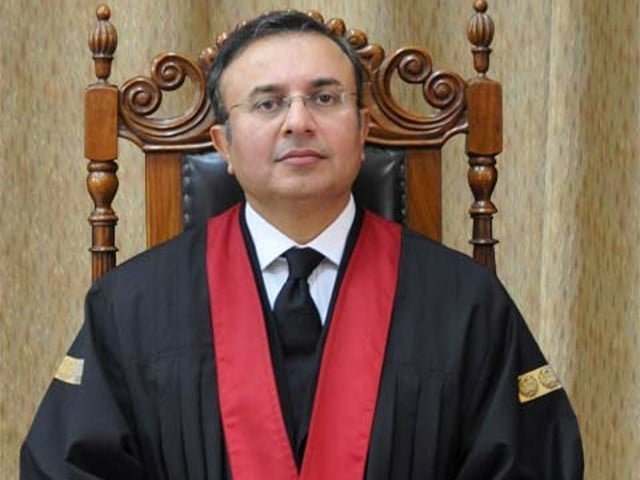

ISLAMABAD: In his additional note regarding the Zulfiqar Ali Bhutto reference, Justice Mansoor Ali Shah highlighted how authoritarian regimes often weaponize political trials to suppress opposition, consolidate power, and legitimize their rule.
He stated that the outcomes of such trials typically depend on the accused’s relationship with the authoritarian government. Justice Shah emphasized that these trials aim to “defame and punish” political opponents, frequently relying on coerced statements from former associates of the accused.
In March, the Supreme Court of Pakistan acknowledged that Bhutto, the founding chairman of the Pakistan Peoples Party, had been denied the right to a fair trial. Almost 44 years after Bhutto’s execution in a murder case, the court ruled that the proceedings in both the Lahore High Court trial and the subsequent Supreme Court appeal failed to meet the fundamental standards of fair trial and due process. This decision came in response to a presidential reference questioning whether the 1979 verdict that led to Bhutto’s hanging could be revisited.
The Supreme Court’s detailed order noted that the conviction was pivotal to the survival of General Ziaul Haq’s regime, making Bhutto’s guilt a political necessity. Justice Shah remarked that political trials serve as “powerful judicial weapons for authoritarian governments,” often compromising justice to achieve predetermined outcomes.
He described Bhutto’s case as a prime example of such a trial, marked by procedural and judicial violations. Justice Shah urged judges under authoritarian regimes to remember that their true strength lies in independence and adherence to principles, not in the mere holding of office.
He praised Justice Dorab Patel for his principled dissent in the Bhutto case, which contributed to Bhutto’s eventual acquittal. Justice Patel’s refusal to take an oath under General Zia’s Provisional Constitutional Order exemplified judicial courage. Justice Shah noted that losing a position is a “small sacrifice” compared to leaving a compromised legacy. He stressed that judges must resist authoritarian interventions immediately, as delays can be “fatal” to the rule of law.
“The judiciary’s role is to defend justice, not undermine it,” Justice Shah declared, adding that judicial integrity must remain paramount in the face of political pressures.
His note also referenced Zulfiqar Ali Bhutto’s writings, underscoring an independent judiciary’s importance. Bhutto argued that an independent judiciary operates under the protection of the Constitution, not under the influence of martial law or military power.
He poignantly described the erosion of democratic institutions, writing: “The executive is in jail, and the assemblies are as silent as a graveyard. Can a flower thrive in a garden that has turned into a desert?”
