

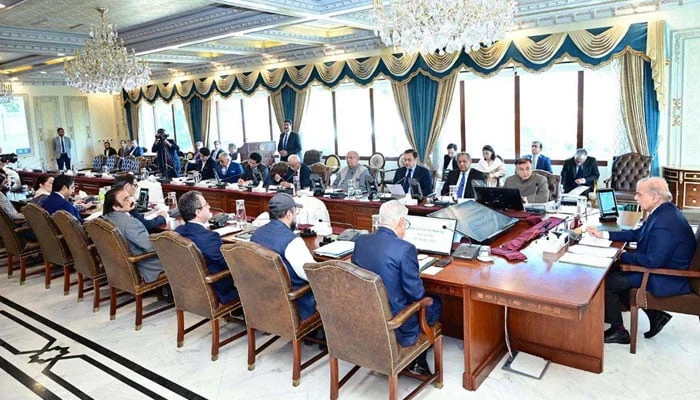

In a decisive move, the federal cabinet has voted in favor of imposing governor’s rule in Khyber Pakhtunkhwa (KP), citing the alleged misuse of state machinery by the provincial government under Chief Minister Ali Amin Gandapur during the Pakistan Tehreek-e-Insaf (PTI) protests. These protests, which were led by PTI in support of the release of their incarcerated leader Imran Khan and demands for judicial independence, led to significant unrest in Islamabad and surrounding cities. The federal government accused the KP administration of using state resources to attack the Centre.
The proposal to impose governor’s rule was presented by Federal Minister Amir Muqam, who called for strong action against PTI, and was backed by a majority of the federal cabinet members. The resolution argued that the KP government had provided a justification for the imposition of governor’s rule by “invading the Centre twice” and using state machinery to undermine federal authority.
The Ministry of Law and the Attorney General also provided their legal advice to cabinet members regarding the potential decision. Following the meeting, sources within the federal government confirmed that most cabinet members supported the move, accusing the KP administration of enabling PTI’s protests, which targeted the ruling coalition.
However, before a final decision could be made, the cabinet opted to consult with coalition partners, including the Pakistan Peoples Party (PPP), and other key stakeholders such as the Qaumi Watan Party (QWP) and the Awami National Party (ANP).
This development comes after PTI’s high-profile “do-or-die” protest in Islamabad, which ended in violence and led to over a thousand arrests, including top PTI leaders. The protests, demanding the release of Imran Khan, resulted in violent clashes with police, leading to charges of terrorism, assault on officers, violation of Section 144, and other offenses against the PTI leadership.
In response to the federal government’s actions, the KP Advocate General’s office has prepared for a legal challenge. Additional Advocate General Inam Yousafzai confirmed that KP’s government is fully prepared to contest any decision to impose governor’s rule in court, arguing that there is no valid reason for such a move. “If a government with a public mandate is functioning properly, why impose governor’s rule?” Yousafzai questioned, emphasizing that the provincial government would challenge any “illegal” actions by the Centre.
Opposition Parties Reject Governor’s Rule
Opposition parties in KP, including the Awami National Party (ANP) and Jamaat-e-Islami (JI), have rejected the proposal for governor’s rule. ANP spokesperson Ehsanullah Khan described the move as ineffective, noting that the imposition of governor’s rule would have little impact as PTI holds a majority in the KP Assembly. He suggested that political tensions could be eased through meaningful dialogue, rather than such drastic measures.
Jamaat-e-Islami’s KP Emir Abdul Wasey labeled the move as “unconstitutional” and vowed strong opposition, accusing the federal government of acting out of malice. He argued that imposing governor’s rule would only further destabilize the region.
Prime Minister Shehbaz Sharif, who had previously called for “tough decisions” to end the politics of agitation, had strongly criticized PTI’s protests, which he labeled as “sedition.” He vowed to break any force that threatened Pakistan’s stability and progress. This sentiment was echoed in his remarks condemning PTI’s disruption of daily life in Islamabad, which included road blockages and the closure of schools and businesses.
The recent protests are part of PTI’s ongoing efforts to secure the release of Imran Khan, who has been imprisoned in Rawalpindi’s Adiala Jail for over a year on various charges. The federal government’s crackdown on the protests led to the dispersal of demonstrators, with KP Chief Minister Gandapur and PTI leader Bushra Bibi fleeing back to Khyber Pakhtunkhwa.
