

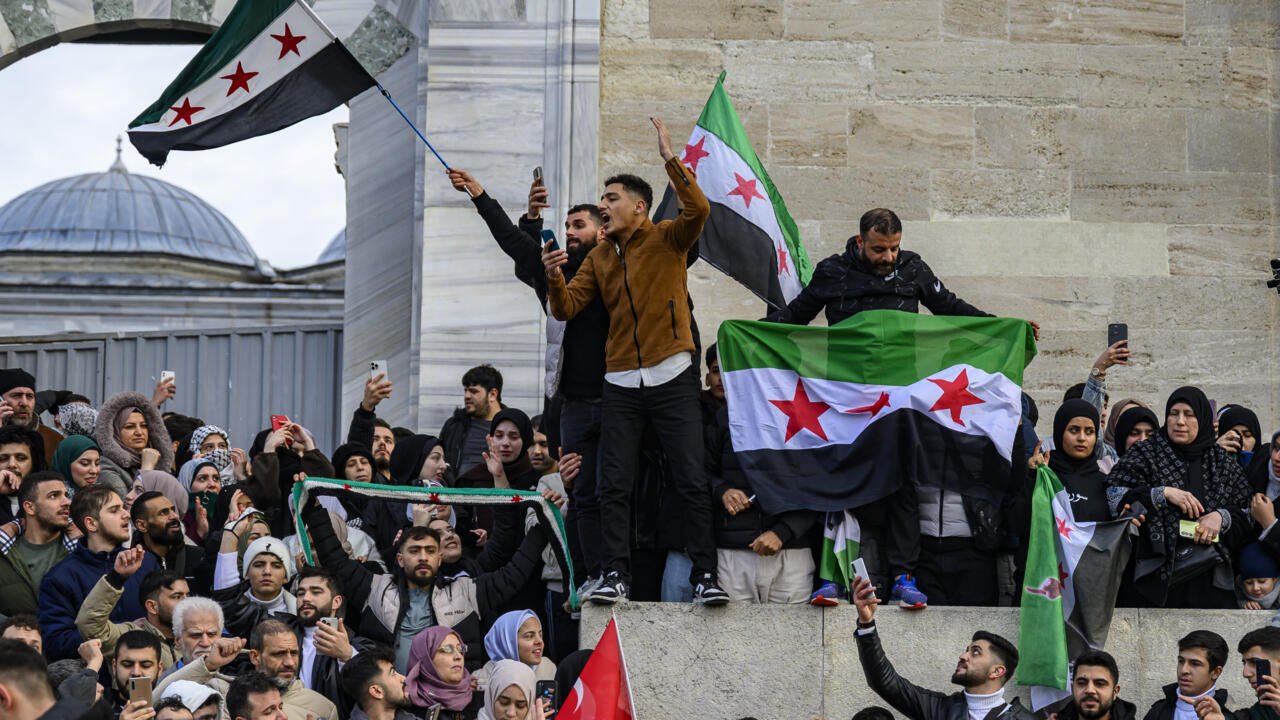

Early Sunday morning, Syrians across the country poured into the streets to celebrate the dawn of their “freedom.”
With the collapse of Syria’s Baath regime and the end of the Assad family’s decades-long rule, crowds toppled statues of Hafez al-Assad, the late father of ousted President Bashar al-Assad, in cities nationwide.
Jubilant anti-Assad activists and social media users hailed the regime’s fall as a victory for the nation. From the capital, Damascus, to the Assad family’s coastal stronghold of Latakia, symbols of the government were dismantled as celebrations erupted.
In Damascus, crowds stormed Bashar al-Assad’s palace, marking a symbolic end to his rule. Media reports showed festivities continuing across the country, with unity and relief dominating the streets.
Syrian state television aired a video statement by a group claiming to represent opposition fighters. They announced the overthrow of Bashar al-Assad, the release of all political prisoners, and called on citizens to safeguard the institutions of a “free Syrian state.”
The Fall of a Dynasty
The celebrations were particularly significant in Hama, a city scarred by the 1982 massacre under Hafez al-Assad when thousands were killed following an uprising. Survivors and family members of the victims saw this moment as justice long delayed. Entire neighborhoods that had been destroyed in that brutal crackdown became rallying points for joy and remembrance.
Videos from Damascus showed people kissing the ground, many in tears, while teenagers smiled widely—scenes of unrestrained emotion rarely seen in a country that has endured decades of fear and repression. Crowds gathered in mosques to pray and in public squares to chant, “God is great.”
A New Chapter
Residents expressed disbelief at how quickly Assad’s regime crumbled after nearly 14 years of devastating civil war. “I did not sleep last night,” said Mohammed Amer Al-Oulabi, a resident of Damascus. “From Idlib to Damascus, it only took them a few days, thank God. May God bless the heroic lions who made us proud.”
In the heart of Damascus, central squares are filled with jubilant crowds. In some areas, celebratory gunfire rang out.
“My feelings are indescribable,” said Omar Daher, a 29-year-old lawyer. “After years of living in fear under Assad and his father, I can’t believe this moment is real.” Daher, whose father was killed by Assad forces and whose brother remains missing in detention, described the fallen regime as a “tyranny finally defeated.”
A New Syria
For many Syrians, the collapse of the Assad regime symbolizes the end of an era of fear and oppression, and the beginning of a hopeful but uncertain future. As they celebrate, the task of rebuilding their country lies ahead.
