

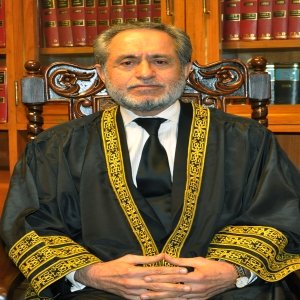

Justice Jamal Khan Mandokhail of the Supreme Court described the law permitting phone tapping as “ambiguous” during a hearing of a constitutional case on Wednesday. The case, presided over by a seven-member bench headed by Justice Aminuddin Khan, examined the authorisation of phone interceptions in the context of national security.
In July, the Ministry of Information Technology and Telecommunication granted the Inter-Services Intelligence (ISI) the authority to intercept and trace calls under Section 54 of the Pakistan Telecommunication (Re-organisation) Act, 1996. However, this decision was swiftly challenged in the Lahore High Court (LHC).
Justice Muhammad Ali Mazhar questioned whether proper legislation governs phone tapping. Additional Attorney General Aamir Rehman explained that laws have existed since 2013, detailing procedures and judicial oversight. Justice Mazhar responded by pointing out that only a judge could authorise phone tapping and asked whether any judge had been assigned for this purpose.
Justice Mandokhail emphasised the lack of clarity in the law, stating that it could affect other ongoing cases. Justice Aminuddin Khan reiterated the need for tangible outcomes rather than just legal explanations.
The advocate on record informed the court that contact had not been made with the petitioner, Major Shabbir, and noted the death of his legal counsel. Subsequently, the court issued a notice to the advocate general and adjourned the hearing.
Separately, during a hearing last December, the Islamabad High Court (IHC) was informed that no intelligence agency had been authorised to intercept audio conversations. This clarification came amid a petition by Bushra Bibi, the wife of ex-Prime Minister Imran Khan, regarding a leaked conversation allegedly involving her and PTI leader Latif Khosa.
