

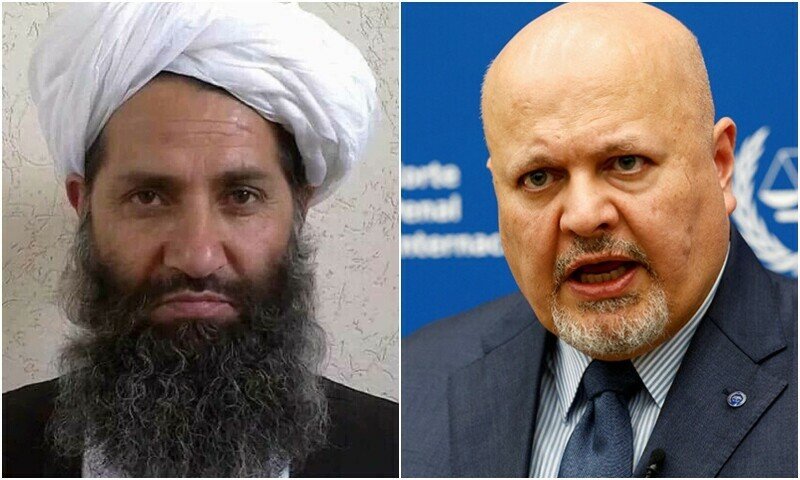

Taliban Leaders
The chief prosecutor of the International Criminal Court (ICC), Karim Khan, announced on Thursday that he is seeking arrest warrants against senior Taliban leaders in Afghanistan over the persecution of women, a crime categorized as a crime against humanity.
Khan stated that there is credible evidence to suggest that Taliban figures, including Supreme Leader Haibatullah Akhundzada and Chief Justice Abdul Hakim Haqqani, bear responsibility for this systematic persecution based on gender.
In his statement, Khan described the persecution faced by Afghan women, girls, and the LGBTQ community as “unprecedented” and “ongoing,” underscoring the severity of the situation under Taliban rule.
He emphasized that the international community must recognize that the status quo in Afghanistan, where these human rights abuses are rampant, is unacceptable. The ICC judges will now review Khan’s application for arrest warrants, a process that may take several weeks or months.
The ICC, based in The Hague, was established to address the world’s most serious crimes, such as war crimes and crimes against humanity. However, since the court lacks its own police force, it depends on the cooperation of its 125 member states to carry out arrest warrants, often with mixed results. In theory, any individual subject to an ICC arrest warrant would be detained if they entered one of these member states.
Khan also indicated that he would soon seek additional applications for other Taliban officials, citing a range of other human rights violations, including murder, imprisonment, torture, rape, sexual violence, and enforced disappearances.
He stressed that the ongoing repression of perceived opposition to the Taliban’s rule, including the targeting of civilians, is a serious breach of international law.
Human Rights Watch (HRW) welcomed the ICC prosecutor’s actions, stressing the importance of putting the Taliban’s exclusion of women and girls from public life back on the global agenda.
Liz Evenson, HRW’s international justice director, stated that the systematic violations of women’s rights have only worsened in the three years since the Taliban retook power, with the perpetrators acting with impunity.
Following their return to power in August 2021, the Taliban initially promised a softer rule but quickly began imposing harsh restrictions on women and girls, drawing widespread condemnation from the international community.
The United Nations has labeled these actions as “gender apartheid.” Key restrictions include barring girls from secondary school, prohibiting women from attending universities, and limiting women’s access to employment, particularly in non-governmental organizations.
Public spaces such as beauty salons, parks, and gyms have been closed to women, and they are required to have a male chaperone to travel long distances.
A “vice and virtue” law introduced last year further restricted women’s freedoms, forbidding them from singing or reciting poetry in public and mandating that their voices and bodies remain concealed outside the home.
Women television presenters are now required to wear headscarves and face masks, in line with a decree issued by Akhundzada. Most recently, women were banned from attending health institutes offering courses in midwifery and nursing, following the earlier university ban.
These measures have drawn sharp criticism from rights groups and the international community, though the Taliban has consistently defended its policies, claiming that they are in line with Islamic law.
The Taliban’s ongoing rejection of international criticism has become a significant obstacle to its pursuit of official recognition from the global community, which it has yet to achieve.
