

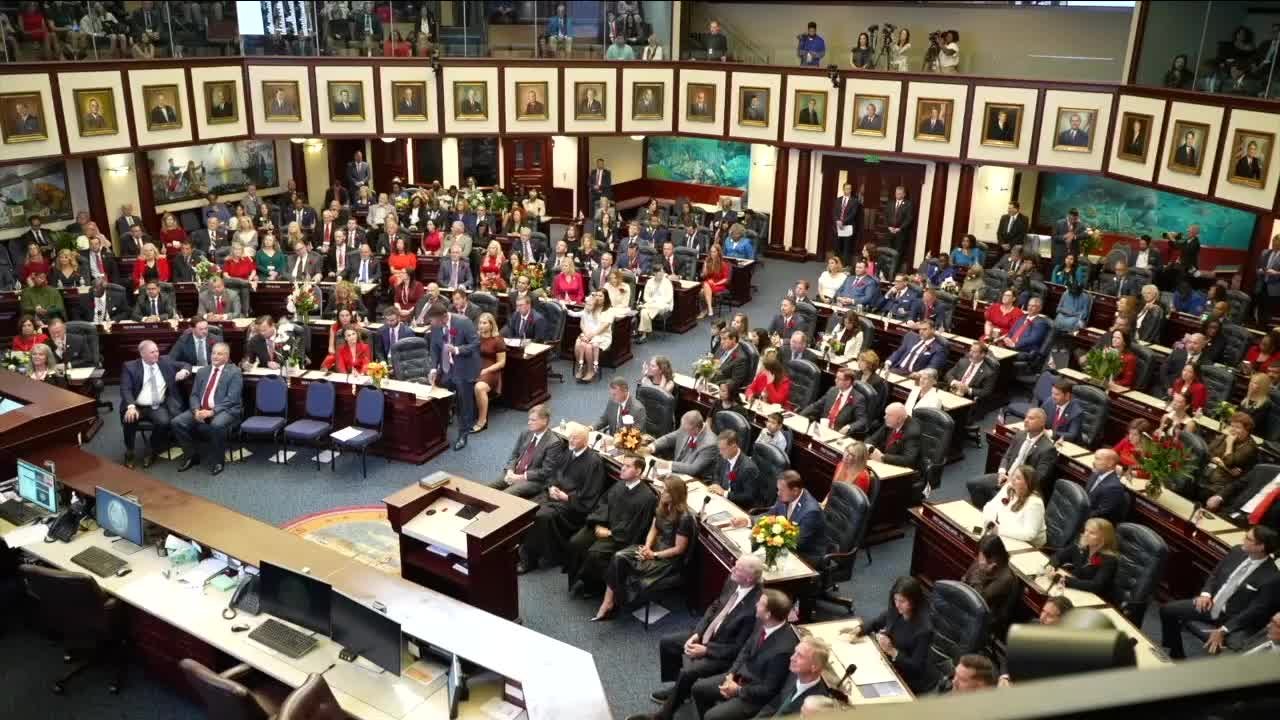

Florida lawmakers passed a comprehensive immigration bill on Tuesday, allocating half a billion dollars in public funds to support President Donald Trump’s immigration enforcement efforts. The bill, titled the Tackling and Reforming Unlawful Migration Policy (TRUMP) Act, was pushed through in a special legislative session, making it more difficult for the public to engage in the process.
The legislation, in a state where roughly one in five residents is an immigrant, mandates that all levels of government, including government contractors, cooperate fully with federal immigration enforcement. After more than four hours of debate, the bill was passed largely along party lines by Florida’s Republican-dominated legislature.
The passage of the bill sets up a confrontation between Republican Governor Ron DeSantis and state legislative leaders, who have been at odds over whose proposals best align with Trump’s immigration agenda. DeSantis has publicly criticized the bill as “weak.”
“The purpose of this bill is to assist President Trump in his efforts,” said Republican Sen. Joe Gruters, a sponsor of the bill and a Trump ally. “He wants maximum coordination with local governments.”
The bill comes after DeSantis rejected previous immigration proposals, signaling a rebuke to the governor who had once been considered a potential successor to Trump. Despite the bill’s passage, one Republican in the House and six in the Senate voted against it, preventing it from securing a veto-proof majority.
“I appreciate the effort, but I can’t support this bill,” said Republican Sen. Blaise Ingoglia, an ally of the governor. “It’s not strong enough.”
Ahead of Tuesday’s floor debate, Senate President Ben Albritton and House Speaker Daniel Perez introduced additional provisions, having received technical assistance from the Trump administration. These included harsher penalties for crimes committed by undocumented individuals and a provision for the death penalty for those convicted of capital offenses.
However, the Republican sponsors declined to include certain proposals from DeSantis, such as restrictions on remittances to foreign countries and a measure that would have presumed undocumented individuals to be flight risks.
Now, Governor DeSantis faces a difficult decision on whether to sign the bill, which he has described as “toothless” and “watered down,” or to veto it. He could also allow the bill to become law without his signature.
The legislation would establish a new state immigration enforcement office with over 140 employees, led by a newly appointed chief immigration officer, who will also serve as the state’s agriculture commissioner. Emergency immigration enforcement powers would be transferred from the governor to this officer.
The bill allocates $100 million for local law enforcement agencies for training, equipment, and reimbursements related to detention facilities for U.S. Immigration and Customs Enforcement (ICE). Additionally, it designates $375 million to fund the state’s cooperation with federal immigration efforts, including deputizing local law enforcement for ICE duties. Another $25 million is earmarked for $1,000 bonuses to local law enforcement officers who collaborate with the federal government.
Democrats have raised concerns about the bill’s language, particularly the broad mandate requiring government employees to “cooperate to the fullest extent possible” with federal immigration enforcement. Democratic Rep. Christine Hunchofsky emphasized the need for clarity on what this cooperation entails.
Gruters clarified that the bill focuses on cooperation from officials overseeing jails and detention facilities, not street-level enforcement. However, he acknowledged that federal priorities could expand the scope of cooperation.
The bill also repeals a 10-year-old law that allowed undocumented students to qualify for in-state tuition at public colleges and universities, affecting approximately 6,500 students in the 2023-2024 academic year. This provision marks a shift in the state’s immigration politics, as the law was originally sponsored by the state’s current lieutenant governor in 2014.
“I ask you to remember what our lieutenant governor said back then—’It’s the right thing to do,'” said Democratic Sen. Darryl Rouson. “What has changed since then except a shift in attitudes toward immigrants?”
Democratic Rep. Jose Alvarez, born in Cuba and brought to the U.S. as a child, was more pointed in his criticism: “You should be ashamed of yourselves. This isn’t what this country was meant for.”
The provision that makes the agriculture commissioner the chief immigration officer has drawn the ire of DeSantis, who expressed concern about the agriculture industry’s lack of experience with immigration enforcement.
In his closing remarks, Speaker Perez addressed the tensions, urging Republicans to focus on the work ahead. “Threatening others to get your way isn’t leadership, it’s immaturity,” Perez said. “Let’s ignore the melodrama and get to work.”
Florida’s immigration bill is part of a broader wave of state-level responses to Trump’s immigration agenda, with other states, such as Tennessee, also taking up similar measures.
