

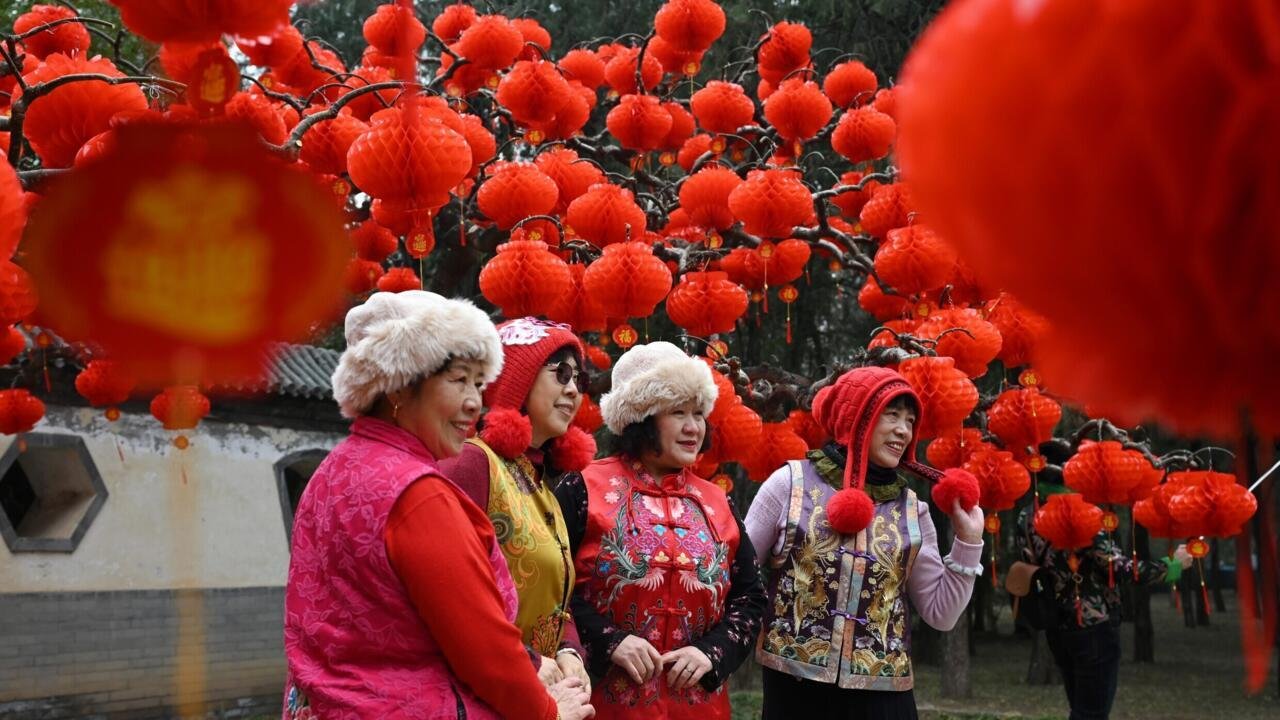

High streets, shopping malls, and homes throughout East and Southeast Asia are adorned with vibrant red banners as hundreds of millions of people celebrate the Lunar New Year on Wednesday, bidding farewell to the Year of the Dragon and welcoming the Year of the Snake.
In China, the Spring Festival kicks off with eight consecutive public holidays, providing an opportunity for families to gather, share meals, attend traditional performances, and light firecrackers and fireworks. Train stations and airports across the country have been bustling with travelers for weeks, as millions of people make their way home for the holiday. This year’s migration is expected to break records.
Throughout much of East and Southeast Asia, including South Korea, Singapore, Vietnam, and Thailand, festive red decorations — believed to bring good fortune and ward off evil — can be seen in public spaces and homes.
In Taiwan on Wednesday morning, people of all ages filled temples across the island, offering fruits, sweets, crackers, and nuts, as they prayed and meditated for a prosperous year ahead.
“Our tradition is to visit the temple and pray for a better fortune in the coming year,” said Chen Ching-yuan, 36, at Longshan Temple in Taipei with her mother. “We don’t ask for anything specific — just a smooth, peaceful, safe, and healthy year.”
Some temple-goers participated in an exciting tradition of racing to be the first to release incense, hoping to secure good fortune. “I didn’t want to look back with regret when I’m older, so I decided to go for it,” said Kao Meng-shun, who won the race at Fusing Temple in Yunlin County.
Snow Disrupts Travel Plans
During the 40-day travel period around the Lunar New Year in mainland China, around nine billion interprovincial trips are expected to be made, with both train and air travel seeing record numbers, according to Chinese news agency Xinhua.
However, heavy snowfall in South Korea has caused disruptions to trains, planes, and buses nationwide as people traveled to visit family. Images from Seoul’s main train station showed passengers carrying gifts wrapped in colorful cloth and luggage, eager to leave the capital. Snow and strong winds led to traffic delays, with authorities warning that the journey from Seoul to Busan — typically a four-hour drive — could take more than seven hours.
As many opted to travel abroad during the break, more than 2.1 million passengers were expected to pass through Incheon International Airport from January 24 to February 2, marking the highest daily passenger count since the airport’s opening in 2001.
Festivities Reach Space
The celebrations even extended into space, with Chinese astronauts Cai Xuzhe, Song Lingdong, and Wang Haoze sending New Year’s greetings from the Tiangong space station. In a video released by the China Manned Space Agency (CMSA), the astronauts, dressed in blue jumpsuits with traditional red cloud patterns, held up paper-cuttings featuring the Chinese character “fu” for good luck.
“In the new year, may all your dreams come true,” said Wang, forming a heart shape above her head.
