


GSP+
ISLAMABAD: The European Union has cautioned Pakistan against assuming that its Generalised System of Preferences Plus (GSP+) status is permanent, emphasizing the need for compliance with human rights and governance obligations.
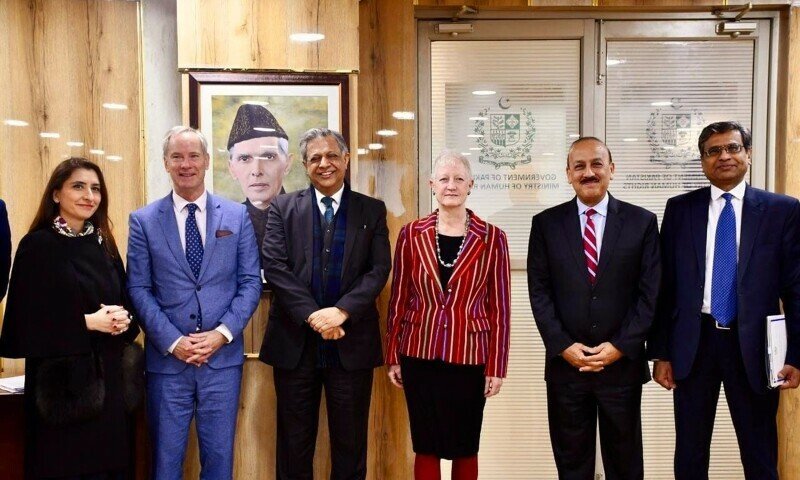
Olof Skoog, the EU Special Representative for Human Rights, who is currently on a week-long visit to Pakistan, has urged the government to uphold democratic norms, particularly in areas such as freedom of expression and the judicial process. He also expressed concerns over the use of military courts to try civilians, a practice that has sparked international criticism.
In an exclusive conversation, Skoog revealed that he had conveyed these concerns in meetings with key government figures, including the army chief, Chief Justice of Pakistan, and members of the federal cabinet.
His visit aims to engage with the Pakistani leadership on pressing human rights issues and to assess the country’s progress ahead of the GSP+ monitoring mission scheduled for June 2025.
Concerns Over Military Courts
One of the key concerns raised by the EU envoy is Pakistan’s use of military courts to prosecute civilians. The EU has previously criticized the sentencing of individuals linked to the May 9 protests, which erupted after the arrest of PTI founder Imran Khan.
Following the announcement of these verdicts, the EU stated that such trials were inconsistent with Pakistan’s obligations under the International Covenant on Civil and Political Rights (ICCPR).
Reiterating this position, Skoog stated, “We have expressed our apprehensions regarding the use of military courts against civilians. Our view is that for civilians, there should be a civilian court system applicable.” He added that while military courts may have a role in specific security-related matters, their use to prosecute protesters and civilians raises serious concerns.
Freedom of Expression and Cybercrime Laws
Another critical issue flagged by the EU representative is the restriction of freedom of expression in Pakistan. His visit coincided with widespread criticism of the government’s amendments to the country’s cybercrime laws, which many journalists and opposition parties view as tools to suppress dissent.
“Our stance is that restrictions on freedom of expression should be minimal,” Skoog emphasized. “You cannot limit free speech merely to shield politicians, authorities, or institutions from criticism. That is not how democratic governance works.”
He noted that media freedom and the protection of civil liberties are fundamental conditions for retaining GSP+ trade benefits, adding that these concerns have been at the forefront of his discussions with Pakistani officials.
GSP+ Future Hinges on Compliance
The EU’s GSP+ scheme provides Pakistan with preferential access to European markets, a trade benefit that has significantly boosted the country’s economy. However, Skoog made it clear that the continuation of this scheme depends on Pakistan’s adherence to international human rights commitments.
“It cannot be taken for granted that GSP+ will be there for the next round,” he warned. The upcoming EU review will assess whether Pakistan has made tangible progress in areas such as labor rights, the abolition of the death penalty, and ensuring due process for detainees.
During his visit, Skoog has met with a broad spectrum of stakeholders, including Deputy Prime Minister Ishaq Dar, Chief of Army Staff Gen Asim Munir, Chief Justice Yahya Afridi, as well as Pakistan’s law and commerce ministers. He has also engaged with civil society representatives, human rights activists, and journalists.
“I am using my visit to convey the concerns raised by civil society in Pakistan,” he stated. “These issues—freedom of expression, labor rights, the death penalty, and cases of individuals languishing in jail without trial—are fundamental to our discussions with the Pakistani authorities.”
With the next GSP+ review approaching, the EU envoy’s visit serves as a reminder that Pakistan must take concrete steps to align its policies with international human rights standards. Failure to do so could put its trade privileges with the EU at serious risk.
