

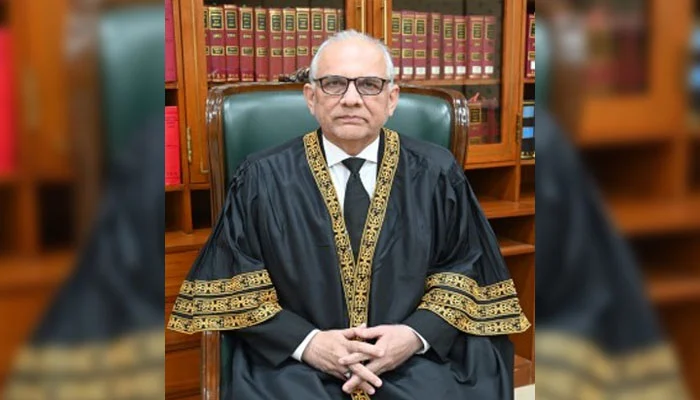

Supreme Court Justice Hasan Azhar Rizvi raised questions on Thursday about whether the offences committed on May 9, 2023, were more severe than acts of terrorism. His remarks came during an intra-court appeal hearing regarding the trial of civilians in military courts, led by a seven-member constitutional bench headed by Justice Amin-ud-Din Khan.
During the proceedings, Khawaja Haris, the Ministry of Defence’s counsel, argued that military courts were not part of the judicial system outlined under Article 175 of the Constitution but were instead established through a separate, recognized law.
In response, Justice Jamal Mandokhail observed that courts established under Article 175 had broad jurisdiction, whereas courts created under specific laws had more limited authority. He noted that the 21st Constitutional Amendment specifically created military courts for wartime situations, and a constitutional amendment was required for the trial of civilians.
However, Khawaja Haris countered that no constitutional amendment was necessary for the trials; rather, the amendment had expanded the Army Act to cover additional offences.
Justice Rizvi, referencing the 21st Amendment, highlighted that it mentioned attacks on military installations such as the Mehran and Kamra airbases. He asked whether the trials for those responsible for attacking the General Headquarters (GHQ) and the Kamra airbase were conducted under military courts. “Two Orion aircraft worth billions were destroyed—was the May 9 offence more severe than these terrorist attacks?” he questioned.
In response to these questions, the defence ministry’s lawyer explained that all terrorists involved in the Mehran base attack were killed.
Justice Rizvi then asked, “Was there no investigation after they were killed? Who were they? Where did they come from? How did they come?” He also asked if the investigation file for the Mehran base attack had been closed after the terrorists were killed.
The counsel further clarified that the GHQ attack case was tried in military courts before the 21st Constitutional Amendment was passed.
Justice Rizvi responded that the amendment was made to ensure smoother trials for attacks like these and avoid legal difficulties.
Justice Musarrat Hilali questioned why there was a distinction between civilians and armed forces personnel when facing trial, emphasizing that the Constitution is the supreme law.
Justice Mandokhail also pointed out that trials of civilians killed by Rangers in Karachi and Turbat had been conducted in civil courts.
Meanwhile, lawyer Khawaja Ahmed Hussain argued that the application of the Army Act suspends fundamental rights. He referenced the law enacted to grant Indian spy Kulbhushan Jadhav the right to appeal in the High Court, while ordinary citizens were denied such rights. Hussain also noted that the federal government had previously claimed that military courts would provide reasoning for their decisions, but it was now stated that no such reasoning was given.
Hussain further argued that Article 8(3) of the Constitution, which excludes the Army Act from fundamental rights provisions, clearly applies only to members of the armed forces, not civilians. He contended that had civilians been meant to be included, the wording would have been different.
Justice Mandokhail then asked if, in that case, the article should have referred to “armed forces” instead of “members of the armed forces.” Hussain agreed, noting that the term “members” implied civilians should not be tried under the same provisions.
After hearing the detailed arguments, the court adjourned the hearing until Friday.
