

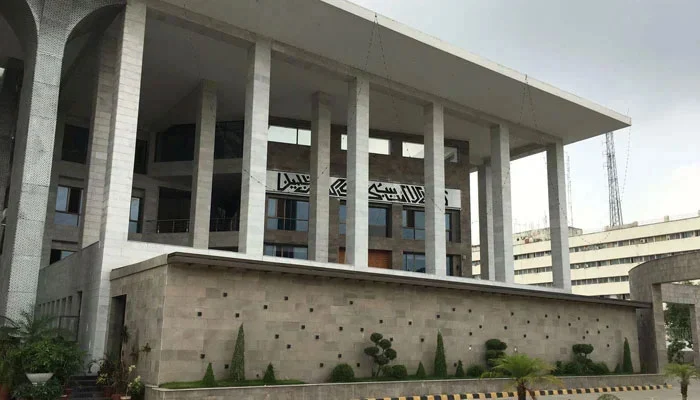

Seven judges of the Islamabad High Court (IHC) have written to the chief justices of the Supreme Court and various high courts, expressing their concerns over reports suggesting that a judge from another high court is being considered for transfer to the IHC and subsequent appointment as its chief justice.
In their letter, the judges referred to widespread media coverage and statements from bar associations regarding the possible transfer of a Lahore High Court (LHC) judge to the IHC for this purpose. They emphasized that such a move would go against established constitutional principles and judicial norms.
The letter was signed by Justices Mohsin Akhtar Kayani, Tariq Mehmood Jahangiri, Babar Sattar, Sardar Ejaz Ishaq Khan, Arbab Muhammad Tahir, Saman Rafat Imtiaz, and Miangul Hassan Aurangzeb.
The development comes as the current IHC Chief Justice, Aamer Farooq, is under consideration for elevation to the Supreme Court. The Judicial Commission of Pakistan (JCP) is set to convene on February 10 to select eight judges from five high courts.
Traditionally, the most senior puisne judge of a high court is appointed as its chief justice. However, following the enactment of the 26th Amendment, the JCP introduced new rules allowing for appointments from a panel of five senior-most judges rather than strictly adhering to seniority.
The IHC judges also mentioned reports that a proposal is under consideration for transferring a Sindh High Court (SHC) judge to the IHC.
Citing Article 200 of the Constitution, the judges highlighted that any high court judge’s transfer requires consultation between the President, the Chief Justice of Pakistan, and the chief justices of both the transferring and receiving high courts.
They further referenced the Supreme Court’s ruling in the Al-Jehad case, which mandates that such consultations must be “effective, meaningful, purposive, and consensus-oriented” to ensure fairness and prevent arbitrary decisions.
The judges urged Chief Justice of Pakistan Yahya Afridi not to advise the President to proceed with such a transfer. They pointed out that a judge transferred to a different high court must take a fresh oath under Article 194, which resets their seniority from the date of that oath.
The letter stressed that making a transferred judge the chief justice of the IHC would contradict constitutional principles, undermine judicial independence, and set a dangerous precedent with far-reaching consequences.
Meanwhile, Islamabad’s legal community has also voiced strong opposition to the move. The Islamabad High Court Bar Association and Islamabad Bar Association, through their respective presidents Riasat Ali Azad and Naeem Ali Gujjar, issued a joint statement rejecting the appointment of an external judge as the IHC chief justice. They warned of potential nationwide protests if their demand for an IHC judge to be appointed as chief justice is not met.
