

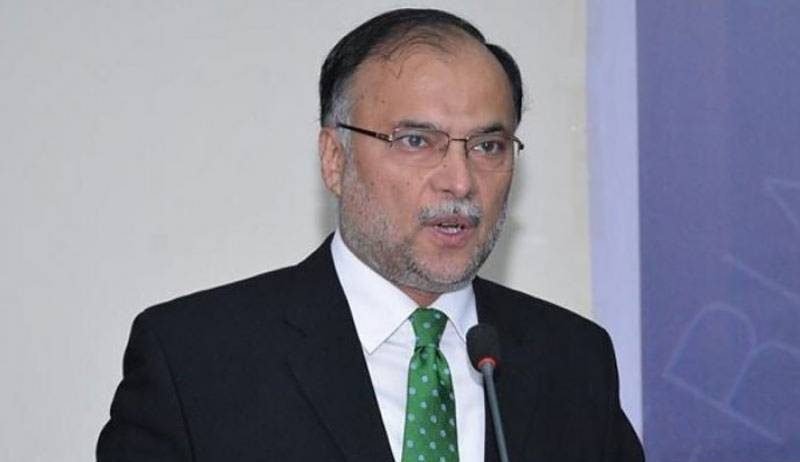

In a landmark debate at the esteemed Oxford Union, Federal Minister for Planning, Development, and Special Initiatives Ahsan Iqbal emerged as a prominent advocate for the Global South, challenging the inherent inequalities within liberal democracy.
Invited by Oxford Union President Israr Kakar, Iqbal argued that liberal democracy has failed developing nations, exposing its double standards and the systemic injustices that obstruct economic justice, political sovereignty, and climate equity.
He contended that while liberal democracy is promoted as the ideal governance model, in reality, it has deepened inequality, fueled political instability, and entrenched economic dependence rather than delivering justice, prosperity, and equality.
Iqbal criticized Western democracies for espousing democratic ideals while simultaneously supporting authoritarian regimes, enabling political repression, and perpetuating economic exploitation in the developing world.
Highlighting global injustices, he called for international recognition of the struggles of Kashmiris and Palestinians, emphasizing their fundamental right to freedom and self-determination.
He asserted that post-World War II global institutions were not designed to empower the Global South but to maintain economic dependence and geopolitical control.
Referencing the collapse of the USSR, Iqbal noted that rather than marking a triumph for liberal democracy, the past three decades have kept the Global South trapped in poverty, suppression, and financial servitude due to exploitative financial structures, trade barriers, and debt traps imposed by wealthier nations.
Citing Jason Hickel’s book The Divide, he highlighted a stark disparity: for every $1 in aid received by the Global South, $14 is lost through exploitative financial systems, including debt repayment and profit repatriation.
Iqbal also criticized the inequity of intellectual property laws, which allowed Western nations to monopolize COVID-19 vaccines, resulting in 1.3 million preventable deaths in developing countries as essential medical patents were withheld for corporate gains.
On climate injustice, he pointed out that while the Global North is responsible for over 80% of historical carbon emissions, it is the Global South that suffers the most severe consequences. He cited Pakistan’s 2022 climate disaster, where floods caused $30 billion in damages, yet financial assistance was offered as loans rather than grants, forcing Pakistan to bear the cost of its own devastation.
Expressing concern over broken commitments to sustainable development, he underscored how developing nations continue to endure environmental crises while powerful states exploit resources unchecked.
Iqbal’s arguments resonated strongly within the intellectually charged atmosphere of the Oxford Union, a venue renowned for hosting some of the world’s most pivotal debates.
The debate concluded with his stance securing 180 votes, surpassing the opposition’s 145 votes—marking a significant victory for Pakistan and the Global South on an international stage.
