


Terror Attacks
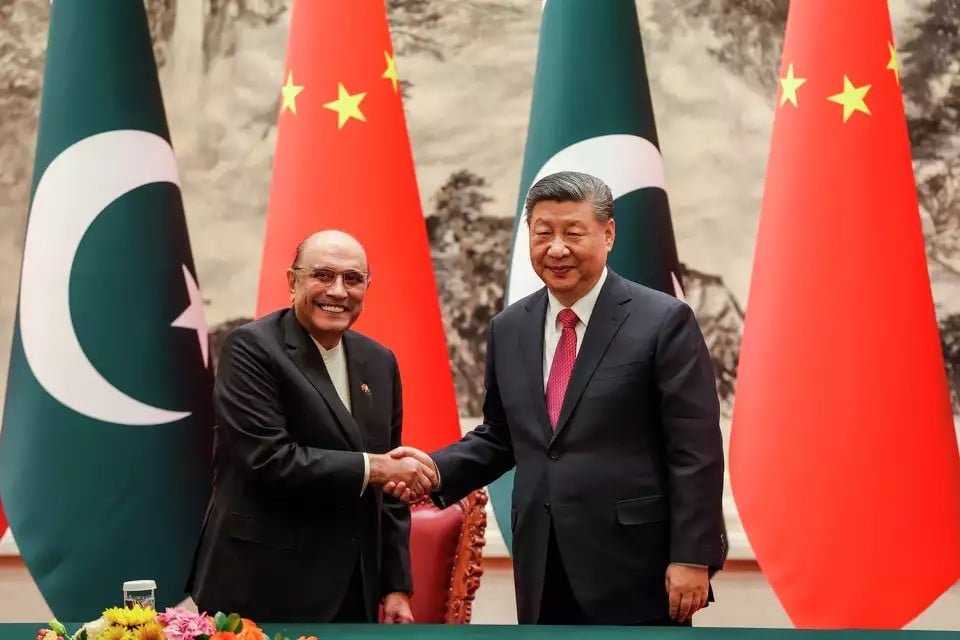
President Asif Ali Zardari reaffirmed Pakistan’s unwavering commitment to its long-standing partnership with China on Wednesday, assuring that militant attacks would not weaken the robust ties between the two nations.
His remarks came during a high-profile meeting with Chinese President Xi Jinping at the Great Hall of the People, where both leaders discussed security concerns and economic cooperation, particularly regarding the next phase of the China-Pakistan Economic Corridor (CPEC).
The meeting took place amid growing concerns in Beijing over the safety of Chinese nationals working on CPEC infrastructure projects in Pakistan.
Recent militant attacks have specifically targeted Chinese workers, raising alarms over the security situation. Despite these challenges, Zardari emphasised the resilience of Pakistan-China relations, stating that their friendship had withstood various tests over the years.
“Pakistan and China will always be friends—true, all-weather friends,” Zardari said. “No matter how many threats, how many challenges emerge, I will stand, and the people of Pakistan will stand with the people of China.”
His reassurances aimed to bolster confidence in the deep-rooted alliance between the two nations, which has historically been a cornerstone of Pakistan’s foreign policy.
The leaders also reviewed the progress of CPEC and deliberated on its next phase, commonly referred to as CPEC 2.0. This phase seeks to move beyond transport and energy infrastructure and focus on industrialisation, agricultural modernisation, and regional connectivity. The expansion aligns with China’s broader Belt and Road Initiative (BRI), aiming to integrate economies across Asia and beyond.
Since its launch in 2013, CPEC has played a pivotal role in Pakistan’s development, with projects such as highways, power plants, and the strategic Gwadar Port.
However, CPEC 2.0 will emphasise economic growth through industrial cooperation, technology exchange, and human resource development. Both leaders recognised the significance of fostering cultural ties and people-to-people exchanges, considering them fundamental to strengthening the China-Pakistan community of shared future.
President Xi acknowledged the strength of bilateral relations, stating, “China and Pakistan have set an example of cooperation between two nations by advancing the construction of CPEC and enhancing collaboration in various fields.” His remarks underscored China’s commitment to deepening strategic cooperation with Pakistan.
The meeting also celebrated the recent inauguration of a Chinese-funded $230 million airport in Gwadar, the largest in Pakistan. Although delayed due to rising attacks in Balochistan, the airport is a vital component of the CPEC vision, further connecting Pakistan to China’s western Xinjiang region and facilitating trade through the Arabian Sea.
Xi reiterated China’s willingness to support Pakistan in its modernisation efforts and reaffirmed his country’s dedication to the success of CPEC. In a symbolic gesture of Pakistan’s deep-rooted ties with China, Zardari formally invited Xi to visit Pakistan, highlighting the immense respect and admiration the Pakistani people hold for the Chinese leader.
Following their discussions, both presidents witnessed the signing of multiple memorandums of understanding (MoUs) aimed at enhancing bilateral cooperation. These agreements covered various sectors, including science and technology, clean energy, socio-economic development, and media collaboration.
The visit concluded with a state banquet hosted by President Xi in honour of the Pakistani delegation, reaffirming the spirit of mutual trust and cooperation between the two nations. The meeting marked another milestone in Pakistan-China relations, sending a strong message that their friendship remains unshaken despite evolving geopolitical challenges.
