


Indian Deportees Scandal
For two weeks, Kulvinder Kaur desperately tried to reach her husband, Harvinder Singh, in the United States. Each failed attempt filled her with anxiety, fearing the worst—that he had been robbed or even killed.
The uncertainty was unbearable, and she had no idea where he was until she saw a news broadcast that shattered her world: President Donald Trump’s administration was deporting illegal Indian immigrants in large numbers.
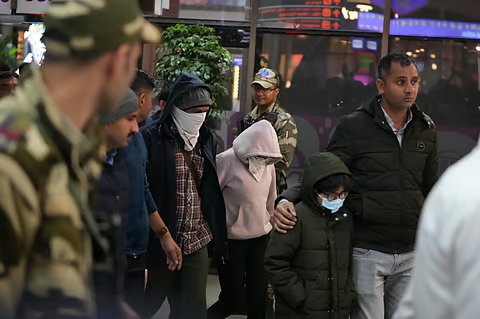
Singh, 40, was among the 104 Indians who had entered the U.S. illegally in search of a better life, only to be deported in a heavily secured operation. The journey back home was humiliating—Singh and others were shackled in handcuffs and leg irons throughout the grueling 40-hour flight to Amritsar. The sight of Indian citizens, bound and paraded toward a U.S. military aircraft for its longest-ever deportation flight, sparked outrage across India.
Just days before Prime Minister Narendra Modi’s scheduled visit to the White House on February 13, the opposition seized on the controversy. Rahul Gandhi and other Congress Party leaders staged a protest outside Parliament, wearing handcuffs in solidarity with the deportees.
Their outrage also carried a political undertone: If Modi and Trump share a strong friendship, as both leaders claim, why has New Delhi failed to prevent such humiliations?
Experts argue that Modi’s government is walking a tightrope. “With the Trump administration, multiple issues are on the table, including trade tariffs,” said Harsh Pant, a geopolitical analyst with the Observer Research Foundation in New Delhi. “India is avoiding confrontation over immigration to maintain diplomatic balance. The government is prioritizing negotiations on tariffs and economic matters rather than making deportations a sticking point.”
‘The Crass Side of America’
Trump’s crackdown on illegal immigration has intensified since he declared a national emergency on the issue. The U.S. has deported planeloads of undocumented migrants, triggering diplomatic tensions with Latin American countries, including Brazil, which condemned the “degrading treatment” of its deported citizens.
Yet, India has remained largely silent, despite similar treatment of its nationals. Among the 104 Indians deported, several were children—though reports indicate they were not restrained. However, others were not so fortunate.
Anil Trigunayat, a former Indian diplomat, called the treatment of Indian deportees “unprecedented.” He condemned the U.S. for “dragging Indian nationals like criminals,” branding it “inhumane and unnecessary.”
Khusboo Patel, a 35-year-old from Gujarat, had barely spent a month in the U.S. before being detained and deported. Her brother, Varun Patel, described her harrowing experience: “She was shackled in chains the entire journey, strictly restricted to her seat.” The family only learned about her return when journalists arrived at their home seeking comments.
“She told us they were treated like criminals,” Varun said. “She wasn’t harmed, but it was horrifying.” He criticized the Modi government for failing to ensure a dignified return for its citizens. “Our government enabled this mistreatment. What can they do for us now? The damage is done.”
Broken Dreams and Crushing Debt
For families like Kaur and Singh’s, the deportation is more than just a physical return—it’s a financial catastrophe. To fund Singh’s journey to the U.S., the couple borrowed more than $55,000 from friends, a local bank, and small-time lenders. They even sold their farmland, but it still wasn’t enough. Now, they are left with nothing but crushing debt.
“We were cheated by the agent who abandoned my husband in a foreign land,” said Kaur, 35, her voice heavy with emotion. “I’m relieved he’s home, but how will we ever recover from this debt?”
This isn’t just their story. Thousands of young Indians, primarily from Punjab, Gujarat, and southern states, continue to take dangerous, so-called “dunki” migration routes in search of a better life. Many sell everything they own, only to find themselves deported and destitute.
According to Vinod Kumar, head of the sociology department at Panjab University, deportation marks the end of both their foreign dreams and their future in India. “They have to start over from scratch,” he said. “The problem is no longer limited to Punjab or Gujarat—it’s spreading across India.”
For Singh and the others who made the long journey back in chains, life has come full circle. They return to the same struggles they tried to escape, only now with heavier burdens and shattered dreams.
