

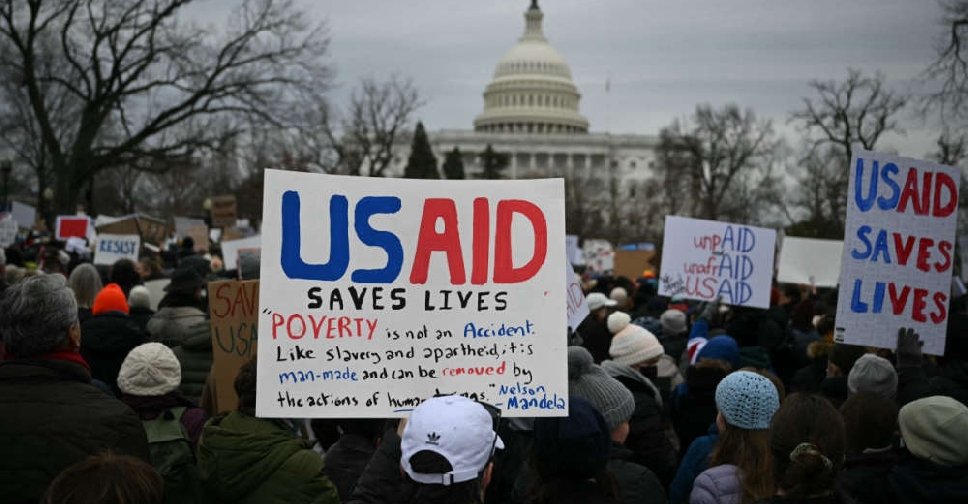

A US judge on Friday temporarily blocked President Donald Trump’s plan to place roughly 2,700 US Agency for International Development (USAID) employees on leave, allowing them to return to work for the time being. The decision pauses parts of the administration’s efforts to dismantle the agency.
US District Judge Carl Nichols, nominated by Trump, partially granted a request from major US government worker unions and foreign service worker associations who had filed a lawsuit to halt the administration’s actions aimed at reducing USAID’s workforce.
The judge’s order, effective until February 14, prevents the administration from moving forward with plans to place approximately 2,200 USAID employees on paid leave starting Saturday. It also reinstates around 500 employees who had already been furloughed. Additionally, the order blocks the administration from relocating USAID humanitarian workers stationed overseas.
Nichols is set to consider a request for a longer-term injunction at a hearing on Wednesday. In his ruling, the judge stated that the unions demonstrated a “strong showing of irreparable harm” if the court did not intervene.
However, Nichols denied the unions’ requests to reopen USAID offices and restore funding for the agency’s grants and contracts.
The Trump administration had informed USAID employees on Thursday that it would retain 611 essential workers out of the agency’s total global workforce of more than 10,000.
Karla Gilbride, a lawyer representing the unions, argued that the significant reduction in USAID’s workforce, along with the closure of offices and forced relocations, exceeded the executive branch’s authority and violated the separation of powers.
Brett Shumate, a Justice Department official, countered, stating that the president had determined there was “corruption and fraud” at USAID, a claim Trump reiterated on Truth Social. Trump accused the agency of rampant corruption without evidence, writing in capital letters, “CLOSE IT DOWN!”
The chaos at USAID began shortly after Trump’s inauguration on January 20, when he ordered a freeze on all US foreign aid to align with his “America First” policy. This move led to a near shutdown of USAID programs, including critical humanitarian assistance worldwide.
Elon Musk, a close ally of Trump and the world’s wealthiest person, has played a significant role in overseeing the reduction of USAID’s operations. In the 2023 fiscal year, the United States allocated $72 billion in foreign aid, a large portion of which was distributed through USAID.
In a separate legal matter, US District Judge John Bates declined to block Elon Musk’s “Department of Government Efficiency” (DOGE) from accessing the US Department of Labor’s systems. This decision marks an early loss for labor unions challenging Musk’s efforts to cut government costs. The AFL-CIO union argued that Musk’s access could allow him to obtain sensitive data about investigations into his companies, including Tesla and SpaceX.
Musk’s government efficiency initiatives have raised concerns, with critics alleging overreach in his efforts to dismantle federal agencies and reduce the federal workforce. In response, the White House has stated that Musk will recuse himself from any matters involving conflicts of interest.
