

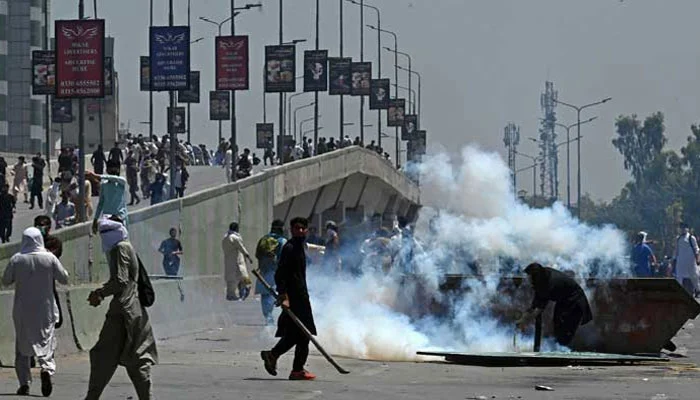

ISLAMABAD: Supreme Court Justice Musarrat Hilali questioned lawyer Salman Akram Raja on Thursday, asking if he acknowledged that a crime was committed on May 9, 2023, and why the emphasis on basic rights has emerged now, after the incident had crossed certain boundaries.
“Limits were crossed on May 9, and now you remember basic rights?” Justice Hilali remarked during the hearing of an intra-court appeal challenging the military trials of civilians. The seven-member constitutional bench was headed by Justice Amin-Ud-Din Khan.
Representing convicted civilian Arzam Junaid, Raja argued that in the United Kingdom, court-martial trials are overseen by high court-style judges rather than military officers, and commanding officers are limited to referring serious cases to an independent forum.
However, Justice Amin-Ud-Din reminded Raja that the bench was concerned with Pakistan’s legal framework, cautioning against wasting time discussing foreign laws. Justice Muhammad Ali Mazhar further clarified that British laws primarily address military discipline, whereas the present case concerns civilians.
“How can such a law be applied to civilians?” Justice Mazhar questioned. Raja responded by saying the British example was cited to emphasize the importance of transparent and independent trials.
Justice Hilali remarked that the pending appeals aim to restore annulled provisions. She stressed the importance of considering international laws in reviewing these provisions, noting that the annulment made the arguments relevant in this context.
Justice Jamal Khan Mandokhail raised a critical question about whether civilians could legally undergo court-martial in Pakistan’s legal framework. Raja firmly responded, saying it was not possible under any circumstances.
The proceedings also touched on unresolved grievances of victims of the Army Public School (APS) attack. Raja highlighted that despite their immense suffering, the victims are still awaiting justice. Justice Amin-Ud-Din acknowledged that achieving a fair trial would require overcoming legal hurdles, including Article 8(3) of the Constitution.
During another exchange, Justice Rizvi questioned the military’s structure, observing that while the army has specialized corps, such as engineering and medical divisions, it lacks a judicial corps. This raised the possibility of reforming the system to include such a body.
