

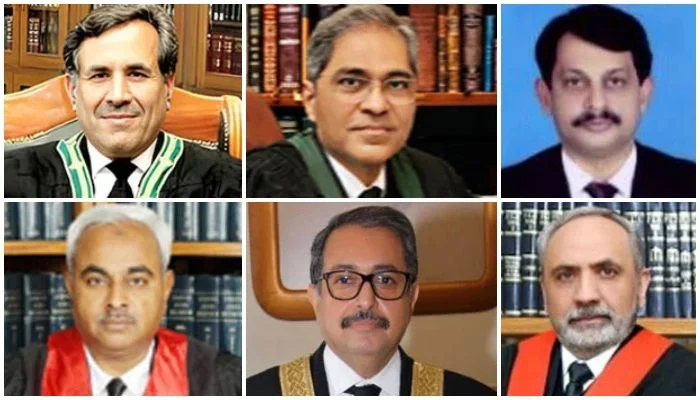

On Friday, six newly appointed judges of the Supreme Court took their oath of office in a ceremony held in Islamabad. Chief Justice of Pakistan, Justice Yahya Afridi, administered the oath to the new judges.
The appointments were not without controversy, as the meeting of the Judicial Commission of Pakistan (JCP) on February 10 saw four members walk out in protest. There was also strong opposition from the PTI and protests from the legal fraternity.
The JCP meeting proceeded despite objections from two Supreme Court judges—Justice Mansoor Ali Shah and Justice Munib Akhtar—as well as two PTI members, Barrister Ali Zafar and Barrister Gohar Ali Khan. They had requested the chief justice to postpone the meeting due to concerns over the 26th Constitutional Amendment.
Lawyers demonstrated outside the Supreme Court building, holding placards and chanting slogans against the 26th Amendment. Nevertheless, the commission, by a majority vote, nominated six judges and acting chief justices of the high courts.
The newly sworn-in judges are Justices Muhammad Hashim Khan Kakar, Muhammad Shafi Siddiqui, Salahuddin Panhwar, Shakeel Ahmad, Aamer Farooq, and Ishtiaq Ibrahim. Additionally, Justice Miangul Hassan Aurangzeb took the oath as Acting Judge of the Supreme Court.
The ceremony was attended by Supreme Court judges, including Senior Puisne Judge Justice Mohsin Akhtar Kayani, Justices Muneeb Akhtar, Ayesha Malik, and Athar Minallah. Also present were judges from the high courts, the Attorney General of Pakistan, representatives from the Pakistan Bar Council, the Supreme Court Bar Association, and other legal professionals.
In a first, the oath-taking ceremony took place outdoors in the Supreme Court’s garden instead of the traditional ceremonial hall.
Justice Sardar Muhammad Sarfraz Dogar Sworn in as Acting Chief Justice of Islamabad High Court
In a separate development, Justice Sardar Muhammad Sarfraz Dogar took the oath as Acting Chief Justice of the Islamabad High Court, administered by President Asif Ali Zardari.
Justice Mansoor Ali Shah Denies Any Rift Among Judges
Following the ceremony, Justice Mansoor Ali Shah addressed journalists, dismissing any suggestions of a rift between Supreme Court judges. When asked about the performance of judges, Justice Shah pointed to the high rate of case disposals, stating, “Look at the rate of disposal of cases. Whose verdicts have been published in law books—those records are available with the Supreme Court.”
When questioned about a potential reference being filed against him, Justice Shah replied that he would address it when it came forward, emphasizing that he had no personal grievances with anyone. He added, “When a reference comes, it will be examined. If nothing wrong has been done, there is no reason to fear. Allah is watching over everything.”
Updated Seniority List of SC Judges
The new appointments have reshuffled the seniority list of Supreme Court judges. After the Chief Justice of Pakistan, Justice Mansoor Ali Shah is now the senior-most judge, followed by Justices Muneeb Akhtar, Aminuddin Khan, Jamal Mandokhail, Muhammad Ali Mazhar, Ayesha Malik, Athar Minallah, Hassan Azhar Rizvi, Shahid Waheed, and Musarrat Hilali.
The updated seniority list includes Justices Irfan Saadat, Naeem Akhtar Afghan, Shahzad Malik, Aqeel Abbasi, Shahid Bilal Hassan, Hashim Kakar, Shafi Siddiqui, Salahuddin Panhwar, Shakeel Ahmad, Aamer Farooq, Ishtiaq Ibrahim, Miangul Hassan Aurangzeb, Sardar Tariq, and Mazhar Alam MianKhel.
