

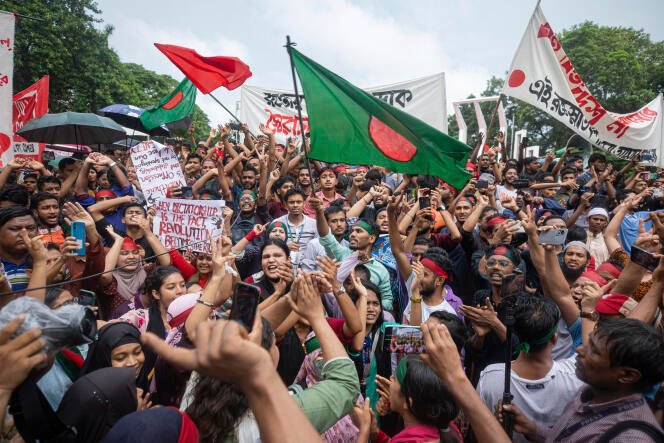

Last year, a student-led revolution toppled the government of Sheikh Hasina, a leader known for her autocratic rule, after public anger over her governance reached a boiling point.
Her ousting has sparked yet another round of revisions to the nation’s history books—a practice that often accompanies a dramatic shift in leadership in Bangladesh. The rewriting of history to reflect the new political agenda has become routine in a country marked by deeply rooted political divisions dating back to the 1971 war of independence.
Until this year, textbooks heavily celebrated the country’s first president, Sheikh Mujibur Rahman, for his pivotal role in leading the liberation struggle. However, Mujib, who was assassinated in 1975 during a military coup, is also the father of Sheikh Hasina, and the family’s ongoing disgrace and exile have diminished his stature in the current political climate.
“The tradition of altering history must stop at some point—the sooner, the better,” Laiba’s mother, Suraiya Akhtar Jahan, told AFP. “Textbooks should not change every time a new government comes to power.”
Bangladesh’s political history remains deeply entangled with the legacy of its independence struggle, and textbook revisions often reflect the political tides. Under Hasina’s government, Mujib’s legacy was central, but his daughter’s policies led to an exclusion of figures from Bangladesh’s earlier history, particularly those opposed to her administration.
“The books had turned into one side’s political manifesto,” said AKM Riazul Hassan, head of the national curriculum reform agency. “That does not conform to the purpose of textbooks. We tried to get them back on track.”
The newly revised history books have removed poems, speeches, and writings by Mujib and depictions of his daughter. Instead, the new curriculum highlights the protesters killed during last summer’s uprising that ousted Hasina and reinstates figures from Bangladesh’s early years who had been erased during Hasina’s time in power.
One such figure is Ziaur Rahman, a former army chief who declared Bangladesh’s independence in 1971. Zia, who founded the Bangladesh Nationalist Party (BNP), Hasina’s main opposition party, had been excluded from textbooks for his political association. His reinstatement signals the resurgence of the BNP, which is expected to perform well in upcoming elections.
‘Endless Cycle’ of Political Change
While the overhaul of the curriculum gives clues about Bangladesh’s political future, critics argue that it leaves important chapters of history out of the narrative.
A major omission in the new textbooks is the brutal purge of Bangladesh’s intellectuals in the final days of the 1971 war, a dark chapter in the country’s history. The killings, which were orchestrated by the Jamaat-e-Islami party, which opposed independence, are mentioned in the revised textbooks, but the involvement of Jamaat is left out.
This omission is significant as Jamaat-e-Islami, suppressed during Hasina’s government, is expected to be a powerful player in the upcoming parliament. The party has also governed in the past in coalition with the BNP.
Dhaka University professor Mujibur Rahman (no relation to the independence leader) told AFP that the intentional obscuring of details about the purge raises concerns about the intentions behind the revisions. “The real question is whether this interim government wants students to learn the actual history,” he said.
Hassan, head of the textbook commission, responded by stating that the purpose of the revisions was to prevent the perpetuation of hatred in the nation’s education. “At some point, we need to start reconciliation,” he said. “Should we make our textbooks flooded with hatred? How rational would it be?”
Changes to Religious Sentiment
Further signs suggest that the new curriculum has also been influenced by religious sentiment in Bangladesh, a Muslim-majority nation.
Under Hasina’s government, significant strides were made in advancing the rights of Bangladesh’s transgender community. However, the new textbooks omit references to transgender issues, a concession to religious groups that had long advocated for their exclusion.
Hassan confirmed that the decision to remove these references came after pressure from Muslim groups. “We took their concerns into account and made adjustments accordingly to minimize their anxiety,” he explained.
