

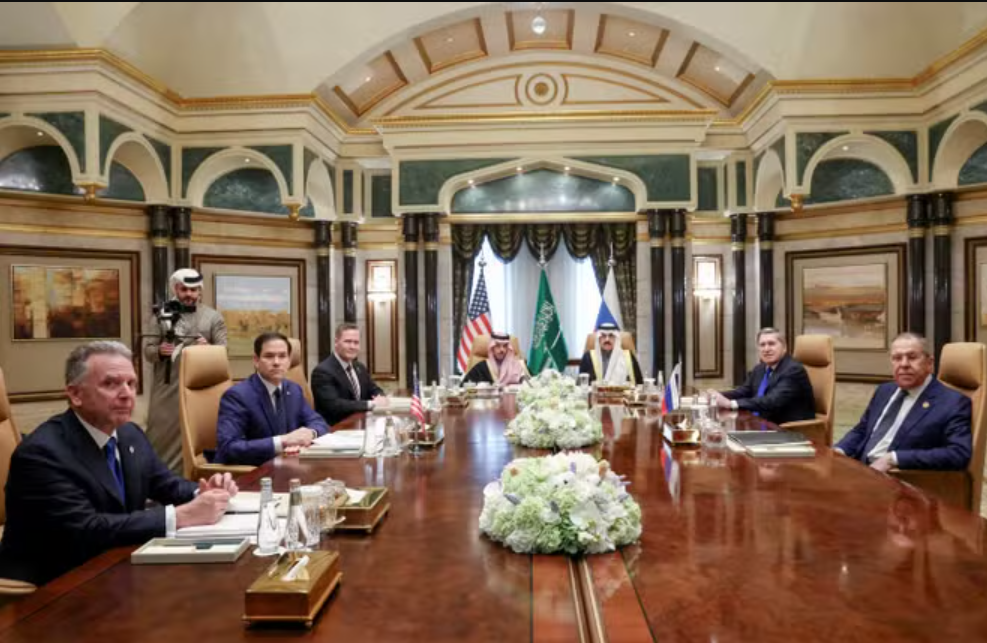

The United States and Russia have agreed to continue efforts toward ending the war in Ukraine following discussions in Riyadh, Saudi Arabia, where Kyiv was not represented.
The 4.5-hour meeting marked the first direct engagement between US and Russian officials on the conflict, making it a pivotal moment in diplomatic efforts to resolve Europe’s deadliest war since World War II. However, Ukraine has made it clear that it will not accept any agreement imposed without its consent.
Before the talks, US President Donald Trump’s administration faced criticism from European leaders for making concessions to Moscow, including ruling out NATO membership for Ukraine and acknowledging the impracticality of Kyiv reclaiming the 20% of its territory currently under Russian control.
US National Security Adviser Mike Waltz emphasized the need for a permanent resolution, acknowledging that negotiations would inevitably involve discussions on territorial adjustments and security guarantees. Secretary of State Marco Rubio reassured Ukraine and European allies that no party was being excluded and that the European Union would need to be involved in the process.
However, even as discussions unfolded, Russia hardened its stance. Russian Foreign Ministry spokeswoman Maria Zakharova stated that NATO’s refusal to admit Ukraine was insufficient. She demanded the alliance formally retract its 2008 pledge that Ukraine would one day join NATO, arguing that failure to do so would continue to destabilize Europe.
Ukrainian President Volodymyr Zelensky has consistently insisted that NATO membership is essential for Ukraine’s sovereignty and security. Ukraine previously relinquished its Soviet-era nuclear weapons in 1994 in exchange for guarantees from Russia, the US, and the UK to respect its independence and territorial integrity.
Russia Introduces New Demands
As European nations debate contributing peacekeepers to support any Ukraine peace settlement, Russian Foreign Minister Sergei Lavrov asserted that Moscow would not tolerate the presence of NATO troops in Ukraine under any circumstances.
Lavrov and Zakharova’s statements indicated that Russia intends to push for further concessions in future negotiations. The opening round of talks saw Lavrov and Kremlin foreign policy adviser Yuri Ushakov—both longstanding figures in Russian diplomacy—engage with three senior officials from the Trump administration, which has only recently taken office.
Both sides confirmed that no date has been set for a meeting between President Trump and Russian President Vladimir Putin, though both leaders have expressed interest in direct talks.
The swift pace of diplomatic engagement, including a Trump-Putin phone call just six days earlier, has raised concerns in Ukraine and across Europe. There is growing unease that Washington and Moscow might strike a deal that overlooks Ukraine’s security interests, rewards Russia for its invasion, and leaves Putin free to pose future threats.
US State Department spokesperson Tammy Bruce stated that both sides had agreed to appoint high-level teams to explore a resolution to the conflict that would be “enduring, sustainable, and acceptable to all parties.”
Russian negotiator Ushakov described the talks as “a very serious conversation” covering key points of concern. Rubio noted that Russia appeared willing to engage in a structured process to end the war, though no concrete agreements had been reached.
Lavrov also highlighted Moscow’s strong interest in lifting economic restrictions imposed by the US and Western allies due to the war. Rubio, however, remained non-committal about the possibility of lifting sanctions, emphasizing that the European Union would need to be involved in any such decision.
