

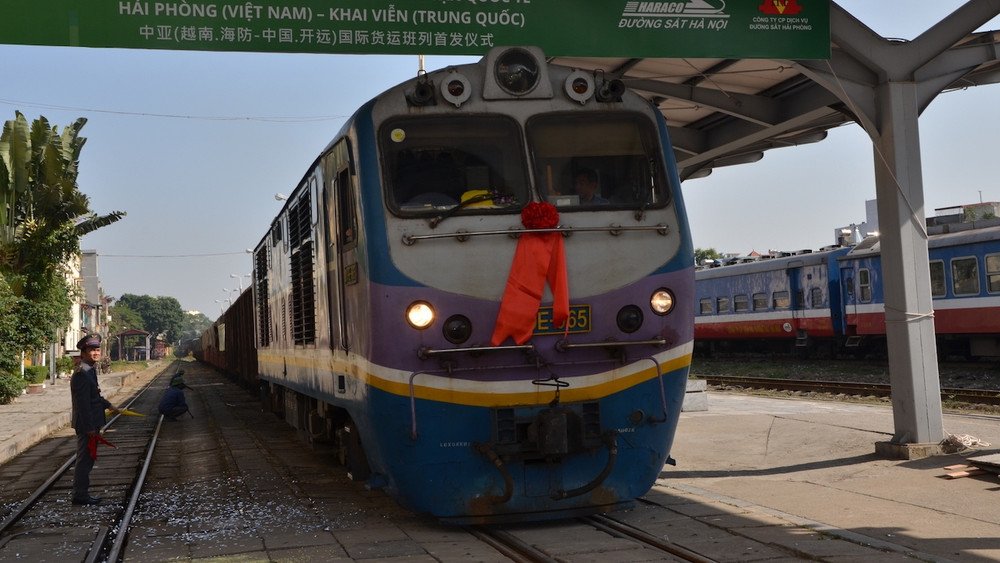

Vietnam’s parliament has greenlit an $8 billion rail project that will connect the northern port city of Haiphong to the border with China, enhancing trade and strengthening ties between the two communist nations. The new rail link is expected to facilitate smoother and faster trade flows, especially for key manufacturing hubs in Vietnam that host global companies such as Samsung, Foxconn, and Pegatron, which rely heavily on components from China.
The 390-kilometer (about 240-mile) rail line will stretch from Haiphong, through Hanoi, and end in the mountainous city of Lao Cai, which borders China’s Yunnan province. The project was approved by 95% of members of Vietnam’s National Assembly, with construction set to begin soon.
China will contribute funding for the railway through loans, and the total project cost is expected to exceed $8 billion. This rail link is one of two planned by Vietnam as part of the “Two Corridors, One Belt” initiative, designed to integrate with China’s Belt and Road Initiative, aimed at enhancing global infrastructure connections.
This move follows a 2022 pledge by Vietnam and China to strengthen their bilateral ties, with Vietnamese officials expressing hope that the new rail link will foster improved economic, trade, and tourism cooperation between the two countries and the broader region.
Vietnam’s transport infrastructure has struggled to keep pace with its growing economy. The country faces challenges with road congestion and an underdeveloped rail network. This new rail project, which will help ease reliance on slower and more expensive truck transportation, aims to support Vietnam’s growing manufacturing sector and strengthen its position as an attractive alternative to China for foreign businesses.
The rail line, spanning nine provinces and cities, will replace an existing colonial-era track, currently limited to speeds of 50 km/h (30 mph). The new system will allow speeds of up to 160 km/h and accommodate both passenger and freight trains.
The Vietnamese government aims to complete the Haiphong-Lao Cai railway by 2030, though past infrastructure projects in the country have faced delays. In addition to this project, Vietnam also approved plans for a $67 billion high-speed rail line connecting Hanoi to Ho Chi Minh City, which will drastically reduce travel time and further boost the country’s infrastructure.
A second rail project, linking Hanoi to Lang Son province, which borders China’s Guangxi region, is also in the works, though it has yet to receive parliamentary approval. Both projects are seen as crucial for enhancing Vietnam’s connectivity and boosting economic growth.
During Chinese President Xi Jinping’s 2022 visit to Hanoi, both nations signed over 30 agreements, including commitments to develop stronger rail links, signaling a deeper collaboration in the future.
