


Speakers Demand End to Arbitrary Legal Amendments
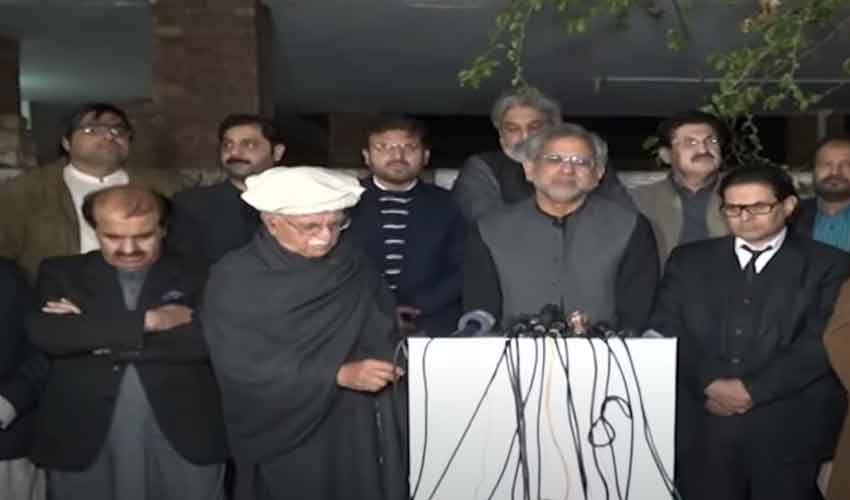
Prominent opposition leaders gathered in Islamabad for a conference titled ‘Supremacy of the Constitution and Rule of Law’ to voice strong criticism against the government’s constitutional violations, legal amendments, and restrictions on political gatherings. The event, organized by an opposition alliance, faced several venue changes and heavy police presence, which leaders condemned as an attempt to stifle democratic discourse.
Demands for Constitutional Supremacy
Mahmood Khan Achakzai, leader of the Tehreek Tahafuz Ayeen-e-Pakistan alliance, emphasized the need for direct public participation in governance. He blamed the “doctrine of necessity” for undermining the country’s system and preventing the benefits of independence from reaching ordinary citizens. “Humans naturally desire participation in governance. The fruits of our independence have not reached the grassroots level. Without justice, peace cannot prevail,” Achakzai asserted.
He also criticized the political establishment for responding to those seeking their rights with allegations, citing an instance where PTI leader Omer Ayub’s grandfather, former dictator Gen Ayub Khan, had imprisoned his father. Despite this, Achakzai expressed satisfaction over Ayub’s embrace of democratic values.
Achakzai reiterated calls for equal participation in governance and proposed granting the Senate equal powers to the National Assembly to ensure proportional representation for all provinces.
Criticism of PECA Law and Recent Legislation
Shahid Khaqan Abbasi, convenor of the Awam Pakistan Party, expressed outrage over recent legislative changes, particularly the Prevention of Electronic Crimes Act (PECA), which he claimed weakened the justice system. “Laws and constitutional amendments have been made to undermine the justice system. The PECA law and other restrictive measures are black laws aimed at suppressing freedom of expression and public gatherings,” Abbasi said. He emphasized the need for consensus before forming any Grand Opposition Alliance and lamented the absence of free speech at the event, which had invited journalists, constitutional experts, and intellectuals to discuss key national issues.
Abbasi also criticized the judiciary’s inaction on constitutional matters, claiming that the chief justice’s refusal to hear constitutional cases had drawn international concern, even from organizations like the International Monetary Fund (IMF).
Alleged Government Suppression of Event
Opposition Leader in the National Assembly Omer Ayub accused the government of violating the Constitution and using security agencies to obstruct the conference. “Intelligence personnel and police were stationed outside. The event was moved to three different venues. Our Secretary General Salman Akram Raja had an arrest warrant issued against him suddenly,” Ayub stated. He claimed the government was actively blocking discussions on constitutional supremacy and the rule of law.
Ayub further criticized the authorities for disregarding the rule of law and hindering open dialogue on constitutional matters.
Fehmida Mirza’s Remarks on Legal Action
Former National Assembly speaker Dr. Fehmida Mirza clarified that she had not challenged her election results but had approached the court regarding the 26th Amendment. Criticizing the current state of parliamentary affairs, she called for stronger institutions, including the military, while advocating for press freedom. “The media must be free, and the remnants of oppression must be eradicated,” Mirza asserted. She condemned the roadblocks set up to hinder the conference, calling such actions contrary to the democratic spirit.
Mirza expressed concern over the disillusionment growing among the youth and said, “The younger generation is losing hope as they see who truly controls the system.”
Salman Akram Raja Calls for Change
Lawyer and politician Salman Akram Raja challenged Pakistan’s enduring political domination, stating, “This domination must be dismantled completely.” He pointed to the increasing support for PTI, particularly among the middle class, and called for unity within the opposition to secure political change. “We must place our trust in this movement,” he urged.
Political and Economic Stability Linked
The conference concluded with a consensus among the leaders that political stability is crucial for achieving economic stability in Pakistan. They called for an end to arbitrary legal amendments and urged all political forces to unite in protecting constitutional rights. The leaders agreed that upholding the Constitution is essential for meaningful political change in the country and that economic stability cannot be attained without political stability.
