

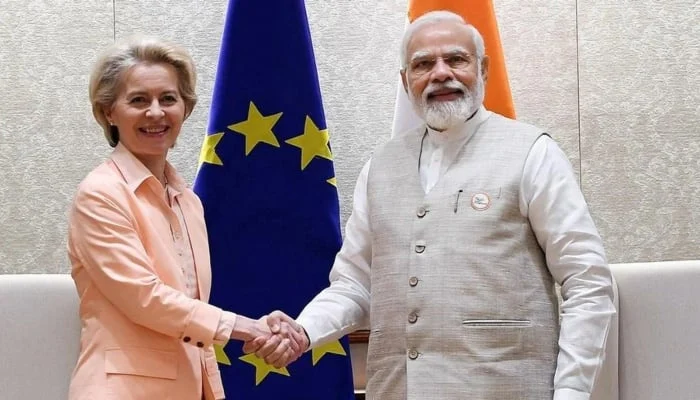

European Union chief Ursula von der Leyen, currently in India for a two-day visit, announced on Friday that the EU is exploring a potential security and defence partnership with India. This move comes as the EU seeks to strengthen its ties with India while navigating tensions with its long-standing ally, the United States.
Von der Leyen’s visit, which began on Thursday, includes a delegation of EU commissioners focused on enhancing diplomatic and trade relations with India, the world’s fifth-largest economy. This comes in the wake of US President Donald Trump’s imposition of tariffs on both allies and adversaries alike.
The EU is also aiming to align with India on shared concerns, including China’s growing influence in the Asia-Pacific, building more resilient supply chains, and establishing governance frameworks for emerging technologies like artificial intelligence.
“I am pleased to announce that we are exploring a future Security and Defence Partnership with India, similar to the partnerships we have with Japan and South Korea,” von der Leyen stated in a speech in New Delhi. “This will allow us to better address common threats, including cross-border terrorism, maritime security issues, cyber-attacks, and attacks on critical infrastructure.”
The EU is India’s largest trading partner, with trade in goods reaching 124 billion euros ($130 billion) in 2023, which accounts for over 12 percent of India’s total trade. However, despite the growing trade potential across sectors such as defence, agriculture, clean energy, and automobiles, India’s market remains largely closed due to high tariffs, and the EU’s share in India’s trade stands at just 2.2%.
The EU is pushing for a trade agreement that would reduce barriers to products like cars, wines, and spirits. Meanwhile, India is looking for increased EU investments in areas such as clean energy, infrastructure, and water management. Indian Prime Minister Narendra Modi has advocated for joint ventures and a streamlined migration policy for skilled professionals.
“A free trade agreement between the EU and India would be the largest of its kind in the world,” von der Leyen remarked. “While it won’t be easy, I’m confident that timing and determination are key. That’s why we’ve agreed with Prime Minister Modi to work towards finalizing it by the end of this year.”
The two sides are also expected to discuss the ongoing war in Ukraine, with India, historically close to Russia and reliant on it for military hardware, maintaining its neutral stance despite Western pressure to distance itself from Moscow.
