

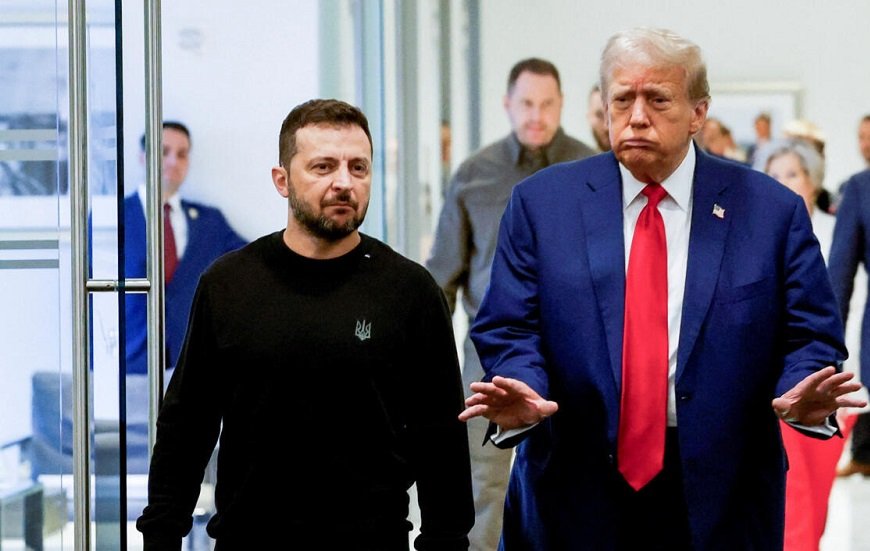

Former US President Donald Trump and Ukrainian President Volodymyr Zelensky engaged in a heated exchange at the White House on Friday, straining relations between Washington and Kyiv at a critical moment in Ukraine’s war with Russia.
Zelensky, who viewed the meeting as a chance to secure continued US support against Russian aggression, instead faced a tense confrontation. Trump and Vice President JD Vance accused Zelensky of disrespect, souring ties with Ukraine’s key wartime ally. Following the clash, a US official confirmed that Zelensky was asked to leave the meeting.
A proposed agreement for joint development of Ukraine’s natural resources, which Kyiv and its European partners saw as a step toward strengthening ties with Washington, was left unsigned and uncertain.
European leaders quickly defended Zelensky, with German chancellor candidate Friedrich Merz emphasizing that the aggressor and the victim should not be equated. Zelensky also held urgent talks with French President Emmanuel Macron, NATO Secretary General Mark Rutte, and EU Council President Antonio Costa. Britain is set to host a meeting with Zelensky and European leaders on Sunday to discuss potential security guarantees for Ukraine.
Since returning to office, Trump has shifted US policy closer to Russia, unsettling traditional allies and leaving Ukraine increasingly vulnerable. Friday’s public confrontation marked the most striking display of that shift.
The situation escalated when Vance called for a diplomatic resolution to the war, while Zelensky countered that Russian President Vladimir Putin could not be trusted. Challenging Trump’s softer stance on Moscow, Zelensky urged him not to “compromise with a killer.”
Trump responded by accusing Zelensky of disrespecting the US and later posted on social media, stating that the Ukrainian leader was “not ready for peace if America is involved.” Speaking to reporters, Trump insisted that Zelensky must accept negotiations to end the war.
Following the meeting’s abrupt end, Zelensky’s scheduled press conference was canceled. He later told Fox News that he hoped relations with Trump could be repaired and expressed some regret over the exchange.
Meanwhile, Ukrainian military chief Oleksandr Syrskyi reaffirmed support for Zelensky, highlighting national unity amid rising concerns about continued US military aid. Public sentiment in Ukraine largely rallied behind Zelensky, though fears of reduced American assistance grew.
Reactions within the US were divided. Democrats criticized Trump’s handling of the meeting, while Republicans were split on his stance. During the conversation, Trump asserted that Ukraine was in a weak position and could gain leverage only by working with the US. Zelensky, visibly frustrated, rejected the notion that the war was a strategic game.
The fallout from the meeting disrupted US-Ukraine discussions on a minerals deal, which Kyiv had hoped would strengthen Trump’s backing for military aid. A senior White House official later confirmed that Trump was not interested in revisiting the deal for now.
Trump also resisted European efforts to secure long-term US guarantees for Ukraine’s security, instead warning that America could withdraw its support. He told Zelensky, “You either make a deal, or we’re out. If we’re out, you’ll have to fight it out alone.”
Amid the tense exchange, former Russian President Dmitry Medvedev appeared to relish the situation, describing the meeting as a “brutal dressing down” for Zelensky.
Following the talks, Trump reportedly directed aides to end the meeting while preparations for lunch were still underway. The abrupt conclusion left the Ukrainian delegation unable to push forward discussions.
The White House meeting underscored the stark contrast between Trump’s approach and the previous administration’s unwavering military support for Ukraine. While Kyiv has strengthened its domestic defense production, it remains reliant on foreign military aid. Ukraine continues to hold significant territory, but Russian forces have gradually advanced since Kyiv’s unsuccessful counteroffensive in 2023.
Trump, who has criticized Zelensky’s leadership and recently called him a “dictator” before walking back the remark, remains firm on his stance to end the war quickly and prioritize US interests. “I hope to be remembered as a peacemaker,” he said.
