

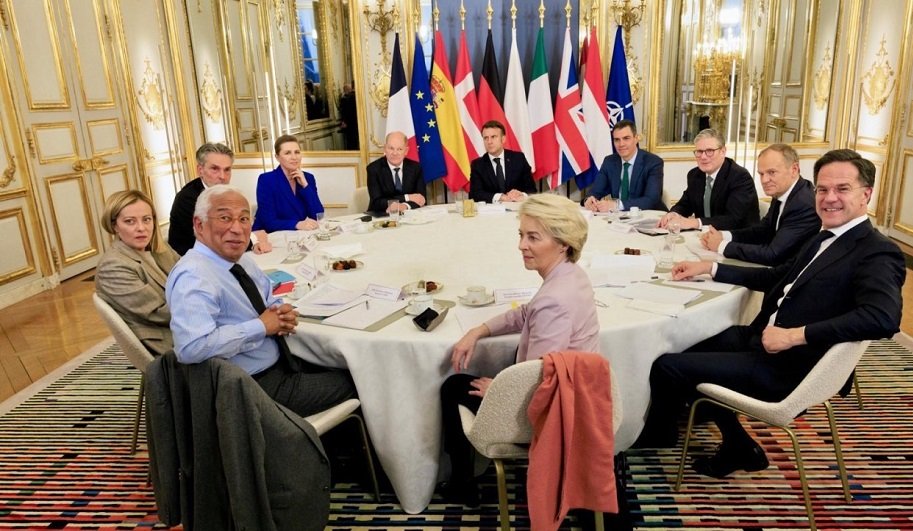

French President Emmanuel Macron has signaled his willingness to explore whether France’s nuclear arsenal could contribute to the protection of its European allies, as he warned that Europe must take the growing threat from Russia seriously.
France and Britain are the only two nuclear powers in Europe, and until now, France’s nuclear deterrence strategy has been strictly defensive, aimed at protecting its own vital interests.
“Our nuclear deterrent protects us: it is complete, sovereign, French through and through,” Macron said in a televised address.
“But, responding to the historic call of the future German Chancellor, I have decided to open the strategic debate on the protection of our allies on the European continent through our (nuclear) deterrence,” he added.
His remarks come after German Chancellor-in-waiting Friedrich Merz raised concerns over NATO’s future and suggested discussing an expanded European nuclear deterrence strategy involving France and Britain.
Strengthening European Defense
Macron also stressed the need for France to increase its defense spending and reaffirmed the country’s commitment to Ukraine. He acknowledged growing public concern over the security situation, especially in light of the new U.S. administration’s foreign policy shifts.
“You are, I know, legitimately worried about current events, which are disrupting the world order,” he said. “Russia has become a threat to France and Europe. To watch and do nothing would be madness.”
European nations have been ramping up their defense efforts following former U.S. President Donald Trump’s decision to freeze military aid to Kyiv, which heightened fears about Washington’s long-term commitment to NATO.
Macron expressed hope that the U.S. would remain a reliable partner but cautioned that Europe must prepare for all scenarios. “I want to believe that the United States will remain at our side, but we must be ready if that is no longer the case,” he said.
France’s Nuclear Legacy
Macron’s willingness to discuss an expanded European nuclear deterrence marks a shift in France’s traditionally independent nuclear posture. The country’s nuclear forces, developed under President Charles de Gaulle during the Cold War, are designed to be independent of both the U.S. and Russia.
France’s nuclear capabilities include both air- and sea-based deterrents, with Rafale fighter jets and nuclear-armed submarines capable of launching strikes on presidential command.
According to the Federation of American Scientists, France possesses around 290 nuclear warheads, while the United Kingdom has 225. The vast majority of the world’s nuclear arsenal—about 88%—remains in the hands of the United States and Russia.
Macron’s comments have already sparked political debate, with far-right leader Marine Le Pen immediately criticizing any move to open discussions on France’s nuclear policy.
As Europe faces heightened geopolitical tensions, Macron’s call for a broader strategic debate on nuclear deterrence signals a potential shift in the continent’s defense approach.
