


Trade War
Canada will remain locked in a trade war with the United States for the foreseeable future, Prime Minister Justin Trudeau stated on Thursday. His remarks came just a day after what he described as a “colorful” yet substantive phone call with U.S. President Donald Trump.
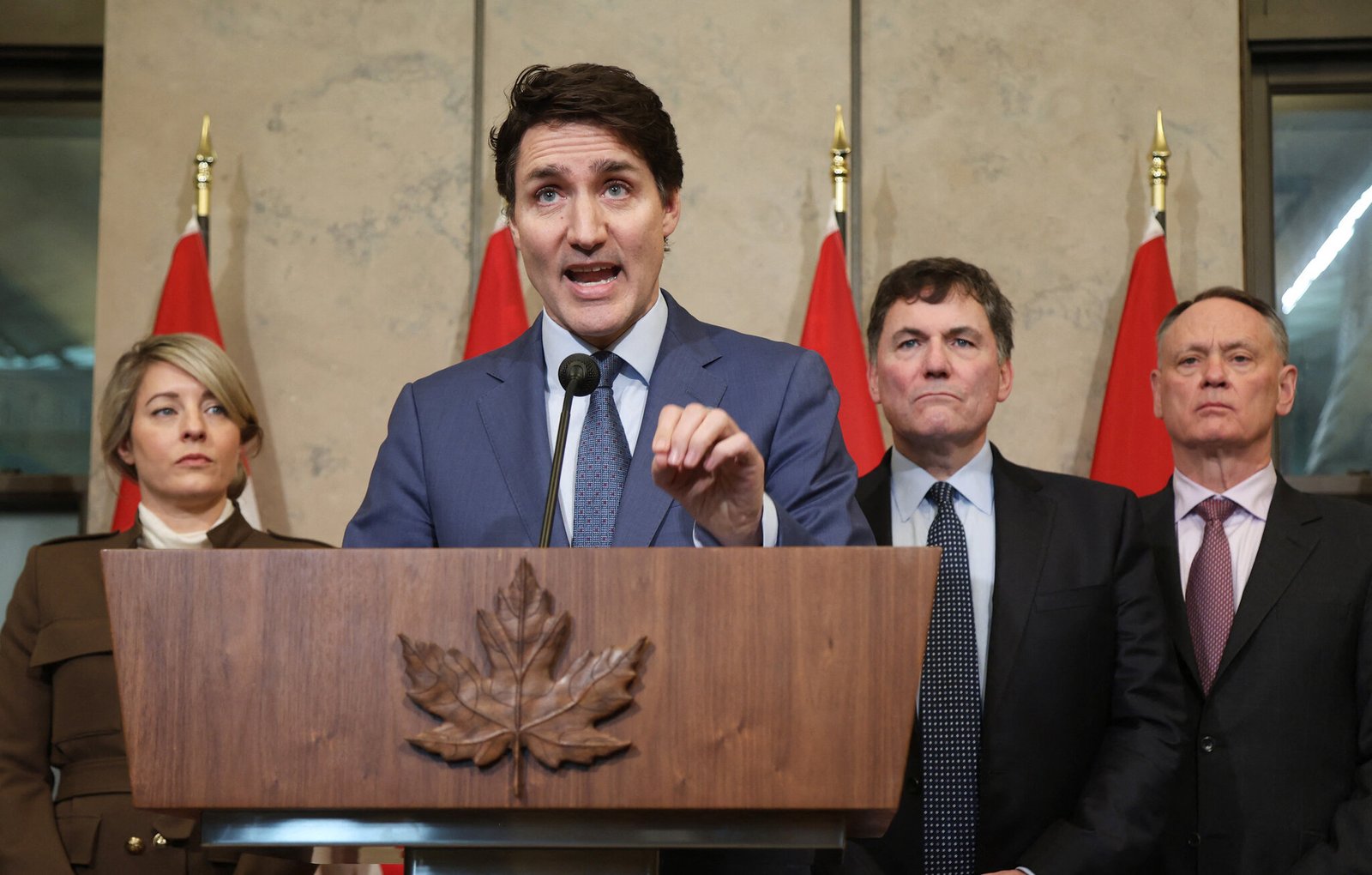
Speaking to reporters in Ottawa, Trudeau reiterated that Canada would continue discussions with senior Trump administration officials regarding the tariffs Washington has imposed on Canadian imports. He reaffirmed that his primary objective remains the removal of these trade barriers.
“I can confirm that we will continue to be in a trade war that was launched by the United States for the foreseeable future,” Trudeau said.
In retaliation to U.S. tariffs, Canada swiftly imposed 25% duties on C$30 billion worth of American imports. Trudeau stated that these countermeasures would remain in effect until the Trump administration rescinds its trade restrictions.
The trade tensions have exacerbated economic uncertainty between the two neighboring countries, which share one of the world’s largest bilateral trading relationships.
Trudeau and Trump engaged in a lengthy 50-minute phone conversation on Wednesday, during which they discussed the ongoing dispute.
The U.S. president has repeatedly accused Canada of failing to curb the flow of fentanyl and illegal migrants across the border. Despite these tensions, Trudeau described the conversation as productive, though he noted there were no immediate breakthroughs.
“It was a colorful call. It was also a very substantive call,” he said, adding that Canada was working to ensure that the tariffs did not cause excessive harm to key economic sectors.
One of the issues under discussion is whether Canada will delay its planned second round of 25% tariffs on an additional C$125 billion of U.S. imports, which is scheduled to take effect in less than three weeks. The Canadian government has not yet made a final decision on this matter.
Meanwhile, the White House announced on Wednesday that Trump would exempt automakers from tariffs on Canada and Mexico for one month, provided they comply with existing free trade regulations. Trudeau welcomed this temporary exemption, emphasizing that any measures that protect Canadian workers—regardless of the industry—would be beneficial.
“Any carve-outs that support any workers in Canada, even if it’s just one industry or another, are going to be a good thing,” he said.
Trudeau also took the opportunity to critique Trump’s approach to international trade negotiations. The Canadian prime minister, who is set to step down once the ruling Liberal Party selects a new leader on Sunday, contrasted trade negotiations with real estate dealings—a clear reference to Trump’s business background.
“A win-lose between us would actually be worse for them than a win-win. That’s true in international trade, in relations between nation-states,” Trudeau remarked.
He further implied that Trump’s perspective on trade might be influenced by his experience in business, where winning at another party’s expense is often seen as an advantage.
“It perhaps is not true in real estate deals, (where) a win-lose is probably better for someone who is experienced in business deals than a win-win,” he added.
As trade tensions persist, the economic relationship between Canada and the U.S. remains uncertain. While both sides continue discussions, no resolution appears to be imminent, leaving businesses and workers in both countries grappling with the ongoing dispute.
