

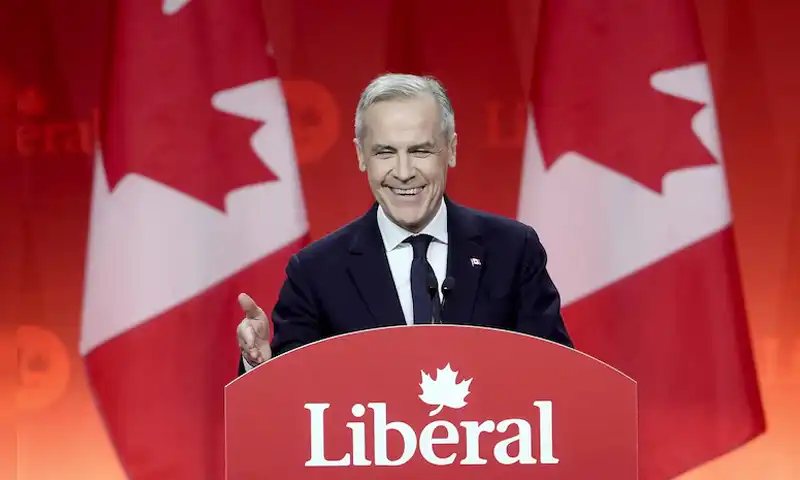

Mark Carney
Mark Carney was officially sworn in as Canada’s 24th prime minister on Friday, taking the helm of a nation facing mounting tensions with the United States following President Donald Trump’s return to power.
Carney, a former central banker with no prior experience in elected office, was chosen by the ruling Liberal Party to replace Justin Trudeau, who stepped down earlier this year. The party’s decision to back Carney was largely driven by his extensive experience in handling economic crises, having previously served as governor of both the Bank of Canada and the Bank of England.
With Canada now facing the prospect of a damaging trade war with its largest trading partner, Carney’s expertise in economic policy is seen as a stabilizing force.
“We’re going to get right to work,” Carney told reporters before taking the oath of office in Ottawa. He confirmed that his first cabinet meeting would take place shortly after the swearing-in ceremony. Diplomatic sources indicated that his first foreign visit as prime minister would be to Europe next week.
Carney’s leadership will be tested immediately as Canada appears to be heading toward a general election in the coming weeks. The campaign is expected to be dominated by concerns over Trump’s policies, which have already disrupted relations between the two countries.
The US president has imposed sweeping tariffs on Canadian imports and has even suggested that Canada is not viable as an independent nation, arguing that it should be annexed by Washington.
Acknowledging the severity of the situation, Carney described Trump’s stance as “the most serious challenge Canada has faced in a generation.” After securing the Liberal leadership, he stated, “Everything in my life has prepared me for this moment.”
His background includes a successful career as an investment banker at Goldman Sachs before leading Canada’s central bank through the 2008 financial crisis and guiding the Bank of England through the economic turbulence caused by Brexit.
Positioning himself as a leader ready to defend Canada’s sovereignty, Carney has emphasized that the country can no longer rely on the United States as a trusted ally. His cabinet reflects this stance, retaining key officials involved in managing US relations.
Melanie Joly remains foreign minister, Francois-Philippe Champagne continues as finance minister, while Dominic LeBlanc moves to trade and Bill Blair remains in charge of defense. Joly, who was attending a Group of Seven (G7) meeting in Quebec, revealed that she was in discussions with US Secretary of State Marco Rubio to arrange a call between Carney and Trump in the coming days.
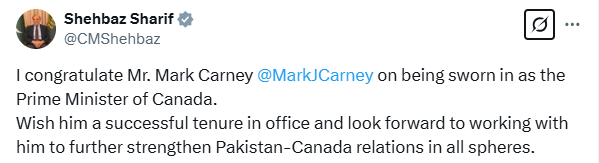
Carney’s assumption of office has drawn international attention, with leaders worldwide extending their congratulations. Pakistan’s Prime Minister Shehbaz Sharif took to social media platform X to congratulate Carney, expressing optimism about strengthening Pakistan-Canada ties.
On the domestic front, Carney’s rise comes at a time of shifting political dynamics. Earlier this year, the opposition Conservatives had a commanding 20-point lead in the polls. However, since Trudeau announced his resignation on January 6, the gap has narrowed considerably, bringing the Liberals back into serious contention. Analysts suggest that Carney’s credibility and economic expertise have played a key role in improving the party’s standing.
Seeking to reassure Canadians impacted by Trump’s economic measures, Carney recently visited a steel plant in Hamilton, Ontario—a major industrial city near the US border. Wearing a hard hat and safety goggles, he vowed to negotiate a new trade deal with Washington while insisting that any agreement must respect Canadian sovereignty.
Carney has also made clear efforts to differentiate himself from Trudeau in an attempt to appeal to centrist voters. While emphasizing the importance of addressing climate change, he has announced plans to repeal Trudeau’s contentious carbon tax on individuals and families, instead favoring market-driven solutions.
Additionally, he has reversed Trudeau’s proposed tax on capital gains for the wealthiest Canadians, arguing that economic growth should be encouraged through incentives for investment.
After nearly a decade in office, Trudeau bid farewell to Canadians in an emotional message on Thursday, saying he was “proud to have served a country full of people who stand up for what’s right.” Though his popularity had declined over the past year, his firm stance against Trump in recent months helped him regain some public support.
Now, with Carney at the helm, Canada embarks on a new chapter—one defined by economic challenges, diplomatic maneuvering, and an upcoming election that could shape the country’s future.
