

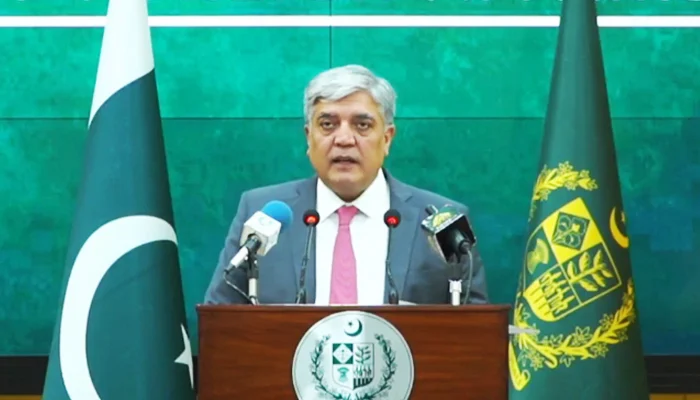

Islamabad reaffirmed on Thursday that India’s fabricated claims of victimhood cannot overshadow its involvement in sponsoring terrorism in Pakistan and its state-led repression in Indian Illegally Occupied Jammu and Kashmir (IIOJK).
During his weekly press briefing, Foreign Office spokesperson Shafqat Ali Khan stated that India’s role in inciting terrorism and destabilizing Balochistan is well-documented.
Addressing reports of India’s involvement in international assassination plots, he highlighted that India’s subversive activities extend beyond Pakistan and affect the broader region.
“Rather than accusing others, India should acknowledge its own record of orchestrating targeted killings, sabotage, and terrorism on foreign soil,” he asserted, further criticizing India’s silence over the recent attack on the Jaffar Express in Balochistan.
Unjustified Claims Over IIOJK
Khan expressed concern over the increasing frequency of provocative statements from Indian leadership regarding Jammu and Kashmir.
He reminded that it was India that brought the Kashmir issue to the United Nations in 1948, and thus, it has no justification for blaming the UN Security Council or its members for the subsequent resolutions.
“Repeating baseless assertions cannot change the fact that Jammu and Kashmir is an internationally recognized disputed region. Its final status must be determined by its people through a UN-supervised plebiscite, as outlined in relevant UN Security Council resolutions,” he emphasized.
He further stated that a peaceful resolution of the Kashmir dispute, in line with UN resolutions and the aspirations of the Kashmiri people, is crucial for lasting peace in South Asia.
Reiterating Pakistan’s commitment to constructive dialogue, he blamed India’s rigid stance and hegemonic ambitions for the continued instability in the region.
“The anti-Pakistan rhetoric emanating from India only worsens bilateral relations and hinders peace and cooperation. This must come to an end,” he remarked.
Prime Minister’s Visit to Saudi Arabia
Briefing the media on Prime Minister Shehbaz Sharif’s recent four-day visit to Saudi Arabia, Khan said the premier had a productive meeting with Crown Prince Mohammed bin Salman.
The discussions focused on strengthening bilateral ties in trade, investment, energy, and security. The prime minister also expressed gratitude for Saudi Arabia’s continued support for Pakistan.
Additionally, he welcomed the signing of the border demarcation treaty between Kyrgyzstan and Tajikistan, marking the resolution of a long-standing dispute.
“We believe this agreement will open new avenues for regional cooperation and progress,” he stated.
Torkham Border Reopening and Deportation Deadline
Commenting on border-related matters, the spokesperson clarified that Pakistan’s deadline for the deportation of illegal foreign nationals remains unchanged. He urged Afghan authorities to take decisive action against TTP and Daesh-K elements responsible for cross-border terrorist activities.
Meanwhile, he announced that the Torkham border has been reopened until April 15, with ongoing efforts to establish a long-term resolution to border-related challenges.
On the issue of visa restrictions, Khan dismissed speculative reports circulating on social media. He reaffirmed that both the Foreign Office and the US State Department have refuted claims regarding the inclusion of Pakistani nationals in any visa-related restrictions.
