

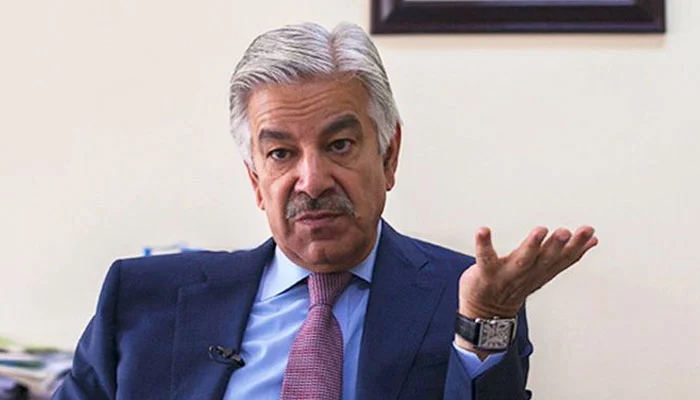

Federal Defense Minister Khawaja Asif has announced that Pakistan will launch a multi-pronged and targeted operation against terrorists.
Speaking in an interview, Asif discussed national security, counterterrorism measures, and government policies. He revealed that the issue of relocating terrorists was addressed in a past National Security Committee (NSC) meeting, though he did not participate, as the matter had already been decided.
The minister stated that during the meeting, Prime Minister Shehbaz Sharif was unable to question former army chief Gen (retd) Qamar Javed Bajwa about the return of terrorists. He added that Mohsin Dawar had objected to the policy and voiced concerns but was prevented from speaking.
According to Asif, approximately 4,000 militants were resettled as a result of this decision, which led to public protests in Swat. He further asserted that terrorist activities in Balochistan have links to Iran and Afghanistan. While Pakistan has targeted militant hideouts across the border, he refrained from disclosing the number of operations conducted.
“There are between 12,000 and 13,000 armed terrorists near the border. If they are not completely eliminated, they will pose a grave threat to the state,” Asif warned.
Regarding the recent NSC meeting, he noted that Khyber Pakhtunkhwa Chief Minister Ali Amin Gandapur neither opposed nor supported the operation. Asif outlined two key strategies to combat terrorism: a kinetic approach involving military action and a combined “soft and hard state” policy.
He reiterated his party’s stance in favor of establishing military courts, stating that the PML-N supports strong governance and decisive action against extremist threats.
Discussing the situation in Balochistan, Asif claimed that tribal leaders now acknowledge that terrorists are no longer under their control and that the issue has been passed on to the younger generation. He cited historical instances, including the execution of Nawab Nowruz Khan under Ayub Khan and the Bugti case under Gen (retd) Pervez Musharraf.
Asif criticized past interventions in Afghanistan, particularly during General Zia’s era, arguing that it was not a jihad but a proxy war between global powers in which Pakistan was used as a pawn.
“The nation stands united against terrorism, but it is crucial to take decisive steps to eliminate this menace at its root before its consequences become more severe,” he cautioned.
Asif also accused Pakistan Tehreek-e-Insaf (PTI) of prioritizing its leader over national security. He claimed that PTI remained indifferent to the fight against terrorism, focusing only on its founder rather than the country’s stability.
“They insist that without their leader, there is no Pakistan. If they truly cared, they would have engaged in discussions rather than making excuses about meeting times,” he remarked.
He also mentioned that PML-N leader Nawaz Sharif has limited his activities due to health concerns, as advised by his doctors.
