

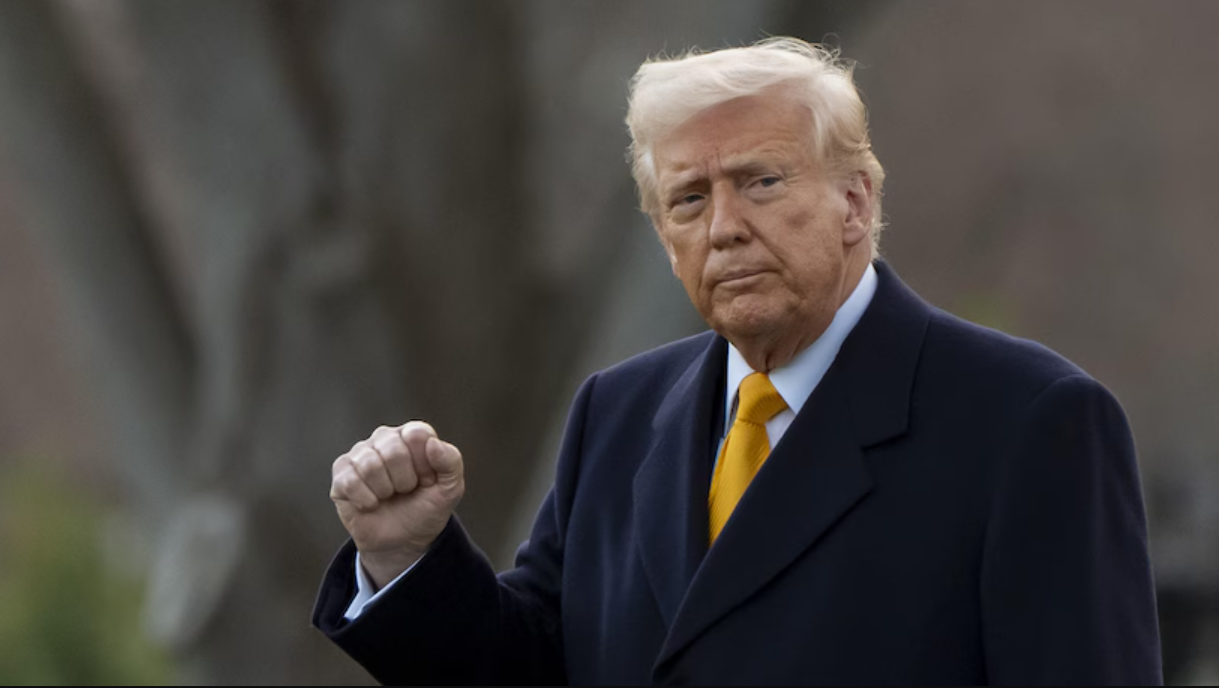

ISLAMABAD: Former U.S. President Donald Trump has asked the Supreme Court to overturn a temporary order preventing him from using a centuries-old law to expedite the deportation of alleged Venezuelan gang members. The request comes as part of his administration’s strict immigration policies, now two months into his term.
The Justice Department filed an appeal urging the court to lift U.S. District Judge James Boasberg’s March 15 order, which temporarily halted the deportations. The order blocked Trump’s use of the Alien Enemies Act, an 18th-century law historically applied only during wartime. The department argued that the case centers on a fundamental constitutional question: whether the president or the judiciary should control national security-related operations.
“The Constitution supplies a clear answer: the president,” the filing stated. “The republic cannot afford a different choice.”
On Wednesday, the U.S. Court of Appeals for the District of Columbia Circuit upheld Boasberg’s temporary block, prompting fresh criticism from Trump, who has frequently voiced frustration with federal court rulings that obstruct his policies.
Legal Battle Over the Alien Enemies Act
Trump invoked the Alien Enemies Act on March 15 to deport suspected members of the Venezuelan gang Tren de Aragua. The law, best known for its use during World War II to intern Japanese, Italian, and German immigrants, allows the president to detain, deport, or restrict individuals with allegiance to a foreign power in times of war or invasion.
However, a group of Venezuelan detainees, represented by the American Civil Liberties Union (ACLU), swiftly sued, arguing that Trump had overstepped his authority since the law applies only during war or invasion—neither of which had occurred.
Judge Boasberg, an appointee of former President Barack Obama, issued a temporary injunction against the deportations. However, the Trump administration proceeded with the deportation of 238 Venezuelans, arguing that the flights had already left U.S. airspace before the court’s written order was issued. The deportees were handed over to Salvadoran authorities at the Terrorism Confinement Centre in El Salvador.
The court is now scrutinizing whether the administration deliberately ignored Boasberg’s verbal order to halt the flights. The Justice Department maintains that verbal orders lack legal weight unless formally documented.
Trump’s Calls for Impeachment and Judicial Tensions
Amid legal pushback, Trump has escalated his attacks on the judiciary, calling for Judge Boasberg’s impeachment. The move has drawn rebukes, including from U.S. Chief Justice John Roberts. On social media, Trump labeled Boasberg a “radical left lunatic” and an “agitator,” despite the judge’s bipartisan confirmation by the Senate in 2011 with a 96-0 vote.
During an appellate court hearing, Judge Patricia Millett made a striking comparison, stating that “Nazis got better treatment under the Alien Enemies Act than has happened here.” A Justice Department lawyer rejected the analogy.
Meanwhile, families of deported Venezuelans contest the government’s gang affiliations. Lawyers representing one deportee, a Venezuelan professional soccer player, claim he was falsely labeled a gang member due to a tattoo of a crown—an homage to his favorite soccer club, Real Madrid.
Separately, Trump announced he had a “productive” phone call with Canadian Prime Minister Mark Carney, pledging to meet after Canada’s upcoming election to discuss political and economic ties.
“It was an extremely productive call. We agree on many things and will meet immediately after Canada’s upcoming election to work on elements of politics, business, and other factors,” Trump stated on Truth Social.
He added that the collaboration “will end up being great for both the United States and Canada.”
The call comes amid rising tensions, with Carney vowing to reduce Canada’s economic reliance on the U.S. Trump, meanwhile, has reignited controversy by suggesting he could make Canada the 51st U.S. state—a remark that has strained relations further.
Carney’s office has yet to issue a statement on the conversation. The exchange also comes ahead of Trump’s anticipated April 2 tariff announcement, which could further impact U.S.-Canada trade relations.
