


Zelensky’s Ouster
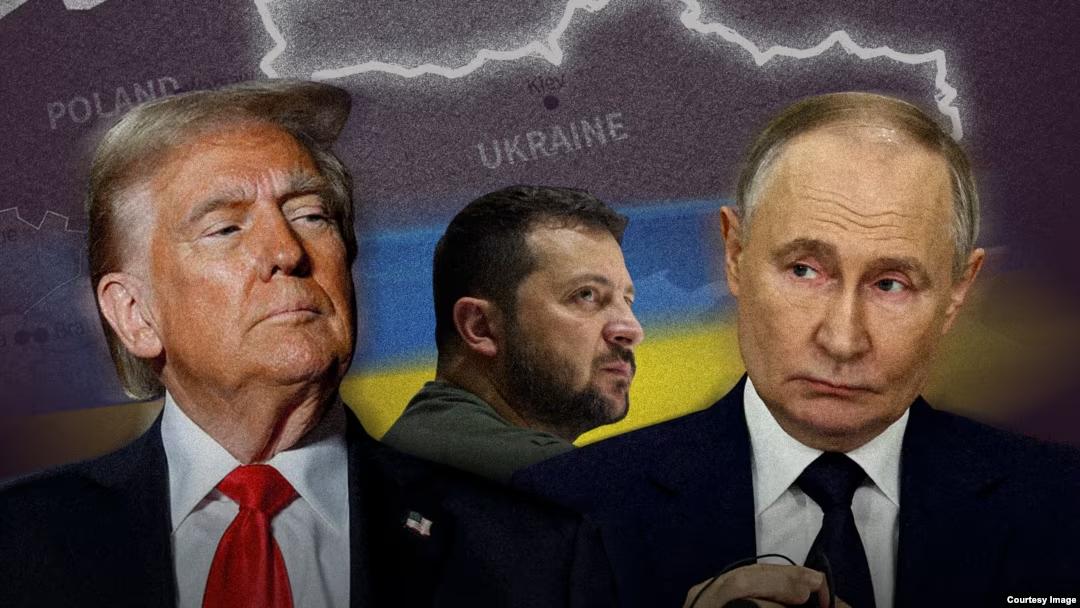
The Kremlin remains determined to exert control over Ukraine by engineering a change in the country’s leadership, as its military efforts continue to falter, multiple sources familiar with Moscow’s strategy have revealed. However, by prolonging peace negotiations, Russia risks alienating U.S. President Donald Trump and missing a crucial opportunity to strike a broader deal with Washington.
Trump expressed his frustration over Russia’s position in an interview with NBC News, saying he was “very angry” and “pissed off” at President Vladimir Putin for questioning Ukrainian President Volodymyr Zelensky’s legitimacy and advocating for leadership change in Kyiv.
Despite ongoing U.S.-Russia negotiations for a peace settlement and preparations for a potential summit between Trump and Putin, the Kremlin has continued pursuing its maximum objectives in Ukraine. Moscow envisions two primary scenarios to achieve its goals.
The first scenario involves Ukraine’s total capitulation, leading to a change in government and a restructuring of the country under Russian influence, effectively turning it into a satellite state similar to Belarus. The second, slightly more moderate, plan would see Russia consolidating control over the four occupied Ukrainian regions while ensuring that Ukraine’s political and military autonomy remains limited.
However, even this latter option remains difficult to accomplish, given that Russian forces have yet to fully secure the occupied territories, and Zelensky has made it clear he will not cede land voluntarily. Instead, he continues to garner military and political support from key Western allies, including Brussels, London, and Paris.
A Russian diplomat highlighted the inconsistency in Moscow’s approach, noting that while the Kremlin continues to label Zelensky’s government a “Nazi regime,” it simultaneously seeks to negotiate with Kyiv. To navigate this contradiction, Moscow is now focused on a third option: discrediting Zelensky in the eyes of Trump, with the aim of pressuring Washington into compelling Ukraine to hold presidential elections.
According to sources, Russian officials believe they have already made progress in this strategy, citing the Feb. 28 Oval Office confrontation as a sign of their success. Putin has even gone so far as to propose that Ukraine’s elections should be conducted under temporary external administration, overseen by the UN and the U.S.—a radical suggestion with little historical precedent.
Putin made this assertion during a visit to the Murmansk region, where he toured the nuclear submarine Arkhangelsk, signaling both to Kyiv and Western capitals that Russia remains a formidable military power. The Kremlin believes that intensifying its rhetoric will force Ukraine to concede to its demands.
Moscow’s fixation on replacing Zelensky stems from the belief that he will never agree to territorial concessions. A source close to the Kremlin stated that removing him is essential to resolving the conflict. This view was echoed by a senior Russian official, who described Zelensky’s departure as a “successful and beneficial” outcome for Moscow.
Putin has consistently argued that Zelensky’s presidency is illegitimate, contending that his term should have ended in May 2024. While he previously recognized Ukraine’s parliamentary speaker as a legitimate counterpart, he now dismisses the entire Ukrainian government as unlawful.
Zelensky, for his part, has stated that he would step down if it meant Ukraine’s admission into NATO. However, Putin remains personally antagonistic toward him, with Kremlin insiders revealing that the Russian leader resents Zelensky for publicly challenging him. As a result, Moscow is aggressively pushing the narrative that Ukraine’s leadership lacks legitimacy and that elections are necessary.
The Kremlin is also attempting to frame Ukraine as a failing state to justify its position to the U.S. Russian diplomats have claimed that Kyiv has failed to uphold a proposed 30-day partial ceasefire, arguing that this demonstrates Zelensky’s loss of control over his military.
Russian Senator Vladimir Dzhabarov, a former KGB officer, reinforced this narrative, asserting that “total chaos” could soon erupt in Ukraine, potentially leading to civil war. He also suggested that Putin’s proposal for external administration could garner support from the U.S., China, and India—though he warned that the EU’s opposition might damage Brussels’ relationship with Washington.
A Russian diplomat indicated that Putin has no intention of making any concessions in peace negotiations as long as Zelensky remains in power. The prevailing view within the Kremlin, he said, is that “even the smallest concession now would be seen as a gift not to Trump, but to Zelensky. That’s unacceptable to Putin.”
Former Russian diplomat Boris Bondarev likened Putin’s approach to Machiavellian tactics, suggesting that the Russian leader is willing to make grand offers—such as handing over Canada and Greenland—if it means securing Ukraine and broader European influence.
Despite Moscow’s attempts to appeal to Trump, its efforts have largely fallen flat. For example, the Kremlin attempted to win favor by renewing the Black Sea grain deal, which Washington announced with great enthusiasm. However, a Russian diplomat admitted that this move had little impact, as Ukraine had already found alternative export routes.
While Russia continues to see itself as the dominant force, it remains unwilling to agree to a ceasefire, even if that could lead to a favorable deal with Trump. This stubbornness has put the Kremlin in a difficult position: unable to secure a decisive military victory yet unwilling to compromise with Ukraine’s leadership.
As a result, Moscow risks undermining negotiations and reversing the recent warming of U.S.-Russia relations. Worse still, if the Kremlin overplays its hand, it may inadvertently strengthen Western unity against Russia—something it has sought to avoid.
A source close to the Kremlin’s foreign policy team warned that failing to seize this moment could provoke an unpredictable reaction from Trump. “If we miss this window of opportunity, Trump won’t just lose interest—he could explode in anger. And then Biden will seem like a kind Santa Claus compared to an enraged Trump. I hope our leadership understands this,” the source said.
Trump himself has already issued a warning to Moscow. Speaking to NBC News, he threatened to impose secondary tariffs on Russian oil if peace talks fail. “If Russia and I are unable to make a deal on stopping the bloodshed in Ukraine, and if I think it was Russia’s fault—which it might not be—but if I think it was Russia’s fault, I am going to put secondary tariffs on oil, on all oil coming out of Russia,” he declared.
Political analyst Georgy Bovt believes that Putin’s push for external governance in Ukraine signals an attempt to portray the country as a failed state. However, Bovt noted that no UN-led external administration has ever been implemented on a truly failed state—making Moscow’s proposal both unprecedented and highly unlikely to succeed.
With peace talks hanging in the balance, the Kremlin faces a crucial dilemma. Its rigid stance could alienate Trump and jeopardize its diplomatic opening with Washington, leaving Russia isolated once again.
