

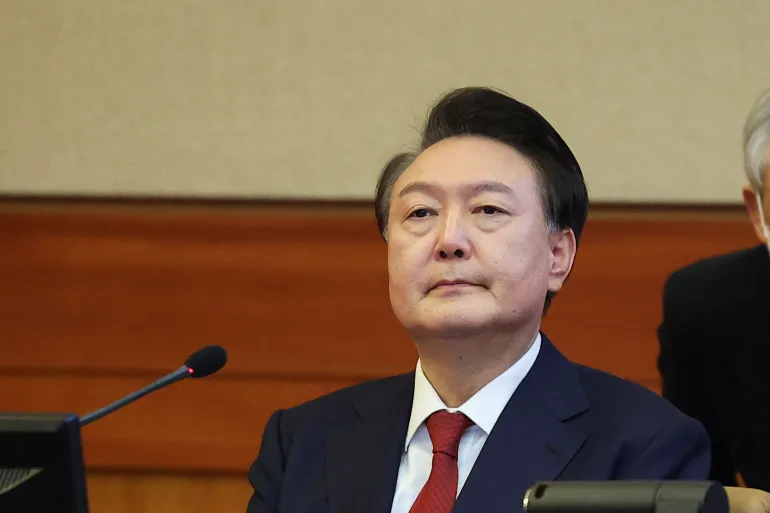

President Yoon
SEOUL: South Korean President Yoon Suk Yeol was officially ousted by the Constitutional Court on Friday after the court upheld parliament’s impeachment motion. The motion stemmed from his controversial declaration of martial law in December of the previous year, which led to one of the worst political crises the country has experienced in decades.
The ruling capped months of political instability, distracting from efforts to address issues related to the administration of U.S. President Donald Trump, as well as the economic slowdown facing Asia’s fourth-largest economy.
With the court’s decision, South Korea is now required to hold a presidential election within the next 60 days, in line with the country’s constitution. In the meantime, Prime Minister Han Duck-soo will serve as acting president until the new president is inaugurated.
Professor Leif-Eric Easley of Ewha University in Seoul noted that the ruling had removed a major source of uncertainty, especially as the next South Korean administration will need to navigate complex issues such as North Korea’s military threats, China’s diplomatic pressure, and U.S. trade tariffs under President Trump.
The court ruled unanimously that President Yoon had violated his constitutional duty by declaring martial law on December 3, 2023. Acting Chief Justice Moon Hyung-bae stated that Yoon’s actions went beyond the powers granted to him by the constitution, calling it a “serious challenge to democracy.”
Moon argued that Yoon’s declaration of martial law had disrupted society, the economy, and foreign policy, betraying the people’s trust.
The decision was met with mixed reactions. Thousands of protesters who had rallied for Yoon’s ouster erupted into cheers, chanting “We won!” in celebration. However, Yoon’s supporters, gathered near his residence, expressed anger, with one protester arrested for smashing a police bus window.
Despite the political drama, the South Korean won remained largely unaffected by the ruling, while the benchmark KOSPI index dipped by 0.7%.
In its ruling, the court rejected most of Yoon’s defense, including his claim that martial law was necessary to address the opposition party’s abuse of its parliamentary majority. The court emphasized that there were legal avenues available to resolve such disagreements, and it described the martial law decree as procedurally flawed and unjustified.
Following the ruling, Kwon Young-se, the interim leader of Yoon’s People Power Party, apologized to the public and pledged that the party would work with the acting president to stabilize the country. Acting President Han Duck-soo assured the nation that he would ensure an orderly and peaceful presidential election.
The political crisis that led to Yoon’s ouster began with his declaration of martial law, which he claimed was needed to root out “anti-state” elements and combat the opposition’s alleged misuse of its parliamentary power.
Yoon had lifted the decree six hours later after parliamentary staff and lawmakers resisted the military’s attempts to enter the parliament building. Yoon insisted that he never intended to impose full military rule and downplayed the fallout, claiming that no one was injured during the confrontation.
Yoon’s legal troubles continue, as he faces a criminal trial on charges of insurrection related to the martial law declaration. He became the first sitting South Korean president to be arrested in January but was later released after a court canceled his arrest warrant.
