

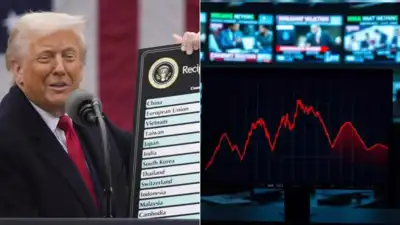

US stock markets experienced their steepest two-day drop since the early days of the COVID-19 pandemic, following President Donald Trump’s announcement of new “reciprocal tariffs.” The markets plunged as fears of a global trade war heightened after Trump’s decision to impose sweeping tariffs on international trade partners.
The Dow Jones Industrial Average fell by 5.5%, the Nasdaq Composite dropped 5.8%, and the S&P 500 shed nearly 6% by Friday’s close. This marks the sharpest decline in US indices since March 2020, when the global economy was jolted by the pandemic and widespread shutdowns.
The market plunge followed Trump’s announcement earlier in the week that he would implement a baseline 10% duty on nearly all imports, with some tariffs climbing as high as 50% on goods from more than 60 countries. The move prompted swift retaliatory actions from key trading partners, most notably China, which on Friday imposed a 34% tariff on American goods—the most significant countermeasure to date.
As tensions escalate, concerns about the potential for a global recession have mounted.
“This is sparking fears of a global trade war,” said Al Jazeera’s Kristen Saloomey, reporting from the New York Stock Exchange. “Investor sentiment clearly reflects those concerns.”
International backlash to the tariff announcement has been swift, with many countries voicing strong opposition. EU Trade Commissioner Maros Sefcovic criticized the 20% tariffs on European goods as “damaging” and “unjustified,” warning that Brussels would take steps to protect its interests if necessary.
Meanwhile, United Nations officials expressed concern over the tariffs’ impact on developing economies. Rebeca Grynspan, head of the UN’s trade and development division, pointed out that poorer nations in Africa and Southeast Asia—many of which rely heavily on trade revenues—would be disproportionately affected.
“Trade should serve development and global growth, not create instability,” Grynspan stated.
Trump Unfazed Amid Growing Criticism
Despite the mounting criticism and economic uncertainty, President Trump remained defiant. Speaking from the Saudi-backed LIV Golf tournament at his Florida golf course, Trump took to Truth Social to reaffirm his position: “TO THE MANY INVESTORS COMING INTO THE UNITED STATES AND INVESTING MASSIVE AMOUNTS OF MONEY, MY POLICIES WILL NEVER CHANGE.”
Trump also pointed to a jobs report that showed 228,000 jobs added in March—data collected before the tariffs were introduced—as evidence that his policies were effective.
Democrats quickly criticized Trump’s public appearances during the economic turmoil. Senate Majority Leader Chuck Schumer accused the president of being out of touch, stating that Trump was living in a “billionaire bubble,” while Senator Ben Ray Lujan remarked, “While the American people are trying to put food on the table, Donald Trump is out there playing golf.”
However, Republicans continued to support Trump’s stance. Senator John Barrasso defended the former president’s approach, describing him as a “deal maker” who would tackle issues “country by country.”
Federal Reserve Warns of Inflation and Job Losses
Adding to the market uncertainty, Federal Reserve Chair Jerome Powell issued a warning on Friday about the potential impact of Trump’s tariff policies. Powell cautioned that the tariffs could lead to higher inflation and increased unemployment.
“We face a highly uncertain outlook with elevated risks of both higher unemployment and higher inflation,” Powell stated during a press briefing.
Powell rejected calls, including one from Trump, to cut interest rates in response to the market turmoil, emphasizing that it was too early to determine if any monetary policy adjustments were needed.
“This is a long game,” Powell explained. “The full effects of the tariffs will take time to assess.”
Global Reactions Intensify
As the weekend approached, the global reaction to Trump’s tariff announcement continued to intensify. Many trade experts viewed the tariffs as a fundamental shift in the global economic landscape, with US allies caught off guard by the drastic move.
Economist Ha-Joon Chang warned that the new tariff regime could lead to a “new world order,” urging the United States to reconsider its approach to multilateral trade agreements.
Among the hardest hit by the new tariff regime are low-income nations, such as Lesotho, Madagascar, and Laos. The Trump administration determined the new tariff rates by matching—or even doubling—the duties these countries impose on US exports.
“The policy hurts the vulnerable and the poor,” the UN stated, urging the US to consider a more development-friendly approach.
With global markets on edge, analysts warned that while the immediate impact of Trump’s tariffs may not be fully evident, they could lead to long-term instability in trade and investment flows, further exacerbating global economic uncertainty.
