


Defence and Energy Deals
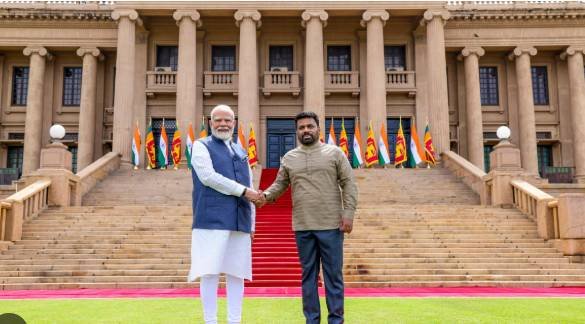
India and Sri Lanka deepened their bilateral relationship on Saturday by signing key defence and energy agreements during Prime Minister Narendra Modi’s official visit to Colombo. The high-profile trip, seen as a strategic counter to China’s growing presence in the Indian Ocean region, marked a significant milestone in regional diplomacy.
Modi was warmly received by Sri Lankan President Anura Kumara Dissanayake, who awarded him the nation’s highest civilian honour in recognition of his “deep personal friendship” with the island nation. The visit highlighted India’s commitment to maintaining regional influence and security cooperation with its neighbours.
“We believe our security interests are aligned,” Modi said during a televised address alongside President Dissanayake. “Our security is interdependent and interconnected.”
The centrepiece of the visit was the signing of a five-year defence cooperation agreement. Under the pact, India will provide training for Sri Lankan military personnel and facilitate the exchange of information and technology, further cementing bilateral military ties.
President Dissanayake assured that Sri Lankan soil would not be used to threaten India’s security, a direct response to India’s long-standing concerns over Chinese military presence in the region.
India has previously protested the docking of Chinese submarines and research vessels at Colombo’s port. Since 2014, Sri Lanka has denied entry to Chinese submarines, and a recent ban on foreign research vessels reflects growing sensitivity to India’s strategic concerns.
Energy cooperation also featured prominently during Modi’s visit. The leaders jointly inaugurated the long-delayed construction of a 120-megawatt solar power project in Trincomalee, a northeastern district strategically located near Indian shores. The joint venture, supported by India, is part of a broader push for sustainable energy and economic collaboration between the two neighbours.
The visit also underscored Sri Lanka’s diplomatic balancing act between India and China. While Dissanayake made his first foreign visit to New Delhi after taking office in 2023, he followed it up with a trip to Beijing, reflecting Sri Lanka’s efforts to maintain ties with both regional giants.
China remains Sri Lanka’s largest bilateral creditor, holding over half of its $14 billion debt at the time of its 2022 default. Beijing’s swift debt restructuring helped Colombo stabilize its economy and attract foreign investment, including a landmark $3.7 billion oil refinery deal in southern Sri Lanka with a Chinese state-owned company — the largest single foreign investment in the island’s history.
Modi’s Colombo trip followed his participation in the BIMSTEC summit in Thailand, where he held a series of regional meetings aimed at consolidating India’s diplomatic footprint.
On the sidelines, Modi met with leaders including Myanmar’s junta chief Min Aung Hlaing, Bangladesh’s interim leader Muhammad Yunus, Nepal’s KP Sharma Oli, and Bhutan’s Tshering Tobgay, further reflecting New Delhi’s renewed outreach across South Asia.
