

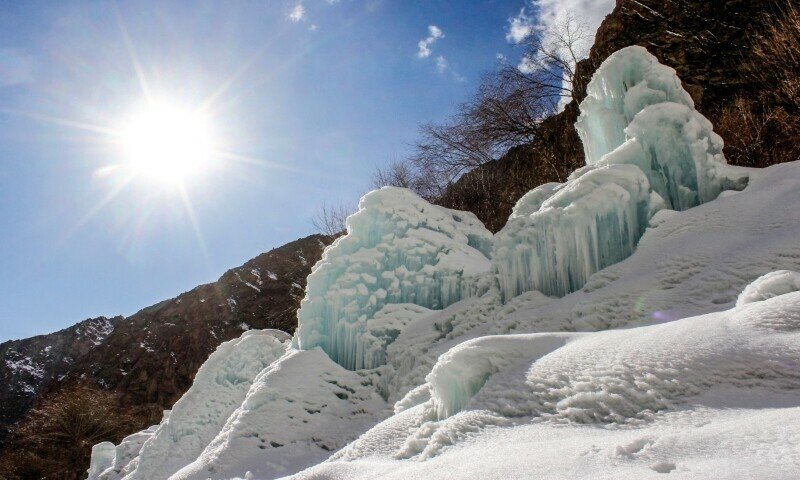

At the base of Pakistan’s towering, frost-covered peaks, farmers facing water scarcity have turned to a creative solution — building artificial ice towers to store water during winter for use in spring and summer.
In the mountainous region of Gilgit-Baltistan (GB), known for hosting K2, the world’s second-highest mountain, traditional snowmelt that once nourished orchards and fields has declined due to climate change and warming winters.
Farmers in the Skardu valley, situated at an altitude of around 2,600 meters (8,200 feet) in the Karakoram range, explored online platforms for irrigation alternatives to support their apple and apricot crops.
“We discovered artificial glaciers on YouTube,” shared Ghulam Haider Hashmi, referring to videos by environmental engineer Sonam Wangchuk from Ladakh, who pioneered the concept nearly a decade ago.
This technique involves channeling water from mountain streams and spraying it into the air during freezing temperatures. The water freezes mid-air, forming towering cone-shaped ice structures — often referred to as “ice stupas” due to their resemblance to Buddhist monuments.
“These ice towers function as natural reservoirs,” explained Zakir Hussain Zakir, a professor at the University of Baltistan. “They slowly melt during spring, providing a steady water supply.”
Gilgit-Baltistan contains over 13,000 glaciers — more than any non-polar region on Earth. The picturesque landscape, marked by high peaks and glacier-fed lakes, draws tourists along the Old Silk Road, now a scenic highway.
Sher Muhammad, an expert on the Hindu Kush-Himalayan mountain system, emphasized that the majority of the region’s water comes from spring snowmelt, not summer glacier runoff. However, snowfall patterns have dramatically changed. “From October to April, we used to see heavy snow. That’s no longer the case,” he noted.
The first artificial glaciers in GB were constructed in 2018. Since then, over 20 villages have adopted the method, giving more than 16,000 people reliable water access without the need for concrete reservoirs, according to Rashid-ud-Din, head of the GLOF-2 climate resilience program in the province.
In Hussainabad, eight stupas were created this past winter alone, storing nearly 20 million liters of frozen water. “We no longer face water shortages at the start of the growing season,” said local farmer Muhammad Raza.
Previously, villagers had to wait until June for glacier meltwater. Now, thanks to these ice structures, fields are irrigated much earlier. “The stupas have saved our farms,” said Ali Kazim, another local farmer.
The innovation has also extended the region’s agricultural productivity. “We used to start planting in May and only got one harvest,” said Bashir Ahmed, a 26-year-old farmer from Pari village. “Now, we can grow crops two to three times a year.”
With temperatures in Pakistan rising at nearly double the global rate between 1981 and 2005, the country faces severe climate threats, particularly regarding water availability. Pakistan’s 240 million people rely heavily on rivers and streams, many of which originate beyond its borders.
Rapid glacial melt, except in some areas like the Karakoram, is expected to intensify flooding and reduce long-term water security.
“Climate change makes everyone vulnerable — rich or poor, urban or rural,” said Yasir Parvi, a 24-year-old resident. “In our village, we decided to act — and the ice stupas were our solution.”
