

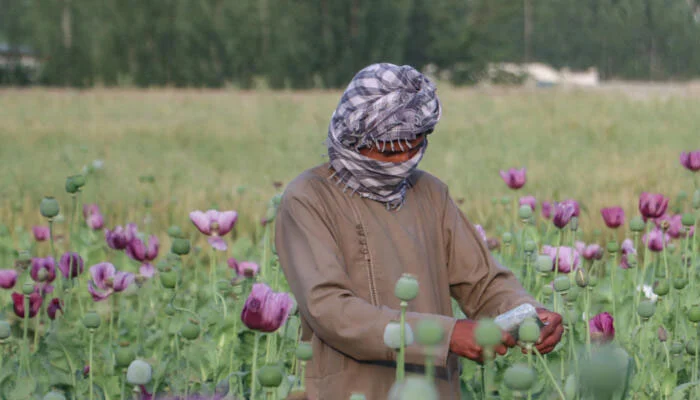

Poppy Farming
A major poppy cultivation operation has been uncovered in the border regions of Khyber Pakhtunkhwa (KP) and Balochistan, specifically in areas near Dera Ismail Khan, according to a report on Monday.
This discovery has sparked alarm among security agencies and policymakers, raising concerns over the growing nexus between drug trafficking and terrorism in Pakistan.
Credible sources have identified the Pastwari and Kochmina areas as key locations for this illicit cultivation. Approximately 25 acres of land, divided into four to five separate patches, are reportedly being used to grow poppy plants.
The total yield from these farms is estimated at 500 kilograms of opium, with a street value of roughly Rs1.6 billion, underscoring the scale and profitability of the operation.
Despite these alarming reports, the Khyber Pakhtunkhwa government and the Anti-Narcotics Force (ANF) have officially denied receiving any such information about poppy farming within KP territory. “We have not received any information from any agency on this issue, but the department has been instructed to investigate the matter. It may be in the Balochistan area,” a provincial official stated, suggesting that the farms might fall under Balochistan’s jurisdiction.
More troubling are reports linking this cultivation to terrorist activity. Sources indicate that at least 40 militants, including high-profile wanted terrorists such as Tariq Kalachi and Habib Ur Rahman, have established hideouts in the area.
Afghan laborers are allegedly employed to work the fields under the financial backing of the “Faizullah Ikhwani Group,” a known militant faction.
Even more concerning is the revelation that opium harvested from these fields is being sold online, with the proceeds believed to be funding terrorist operations across Pakistan. This not only exacerbates internal security threats but also adds to regional instability.
Experts note that the sharp drop in opium production in Afghanistan following Taliban crackdowns has created a vacuum now being filled by Pakistani border regions.
This shift poses a serious threat, as criminal and terrorist networks are increasingly turning to Pakistan to sustain their drug operations.
Security officials have stressed the urgent need for a coordinated response. A comprehensive counter-narcotics strategy involving the ANF, civil administration, and law enforcement is essential.
Without immediate action, these illicit networks could further entrench themselves, escalating the threat to both national and regional security.
