

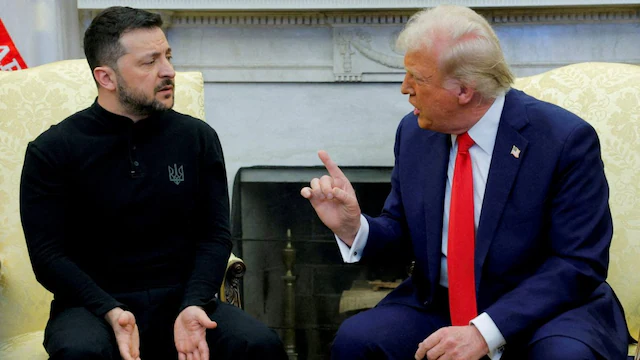

U.S. President Donald Trump launched a scathing attack on Ukrainian President Volodymyr Zelensky on Wednesday, blaming him for prolonging the war due to his refusal to accept Russia’s annexation of Crimea.
In a post on Truth Social, Trump claimed that a peace agreement had been within reach, but Zelensky’s rejection of U.S.-proposed terms would only extend the conflict and the bloodshed. He referred to Ukraine as a “killing field” and accused Zelensky of hindering peace efforts.
Trump’s remarks followed lower-level diplomatic talks in the UK involving American, Ukrainian, and European representatives. Ahead of his comments, Vice President JD Vance outlined Washington’s vision for ending the war — a plan that would allow Russia to retain control over territories it currently occupies, including Crimea.
Zelensky firmly dismissed the proposal, stating it violated Ukraine’s constitution. In response, Trump accused him of arrogance, claiming Zelensky had taken a “very harmful” stance in ongoing negotiations and warning that Ukraine risked losing even more territory by continuing the fight.
“Crimea was lost long ago and shouldn’t even be discussed,” Trump asserted, referring to the Black Sea peninsula with deep historical and military ties to Russia.
Trump, seeking to fulfill his campaign promise of resolving the conflict within 24 hours, has increased pressure on Kyiv while offering potential relief from U.S. sanctions as an incentive for Moscow to cease its invasion. No similar pressure has been publicly applied to the Russian government.
Vice President Vance, speaking during a trip to India, elaborated on the U.S. approach, describing it as a “freeze” of territorial lines close to their current positions. This would effectively mean Ukraine ceding large areas of land to Russia. He stated that both sides would have to compromise on territory but did not clarify what Russia might be expected to relinquish.
According to Vance, the U.S. has put forward a clear peace proposal to both parties, warning that if there is no agreement, Washington may withdraw from the peace process.
Speculation is mounting that the U.S. may recognize Russian control over Crimea to incentivize a ceasefire, a notion that has alarmed several European leaders. The French presidency reaffirmed its support for Ukraine’s territorial integrity and its aspirations toward Europe, while a spokesperson for UK Prime Minister Keir Starmer emphasized that Ukraine must determine its own future.
UK Foreign Secretary David Lammy was initially scheduled to host a ministerial-level meeting in London, but the session was downgraded to lower-level talks, reflecting the diplomatic tensions at play.
Meanwhile, U.S. envoy Steve Witkoff is expected to travel to Moscow for further discussions.
The political turmoil follows a new wave of Russian attacks, breaking a brief Easter truce. A Russian drone strike targeted a bus carrying workers in the southeastern Ukrainian city of Marganets, killing nine and injuring over 30, according to regional officials.
Additional air strikes were reported in Kyiv, Kharkiv, Poltava, and Odesa. In response, Zelensky called for a swift and unconditional ceasefire.
Russian authorities reported one person injured by Ukrainian shelling in the Belgorod region.
