

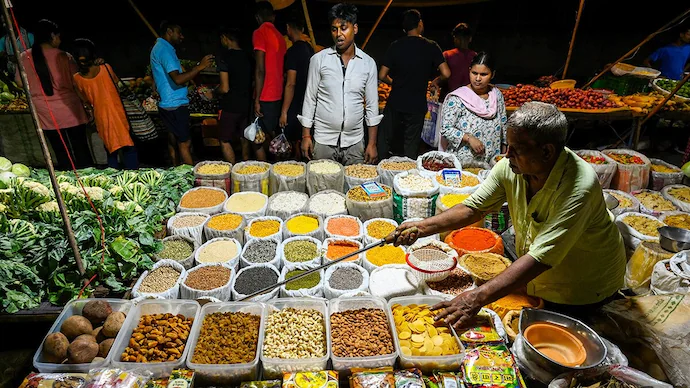

Inflation Drop
KARACHI: Pakistan’s inflation rate fell to a historic low in April 2025, with the Consumer Price Index (CPI) recording a mere 0.3% year-on-year (YoY) increase, according to data released by the Pakistan Bureau of Statistics (PBS).
This marks a dramatic decline from 17.3% recorded in April 2024 and 0.7% in March 2025, making it the lowest inflation figure in the country’s recorded economic history, as confirmed by brokerage firm Arif Habib Limited.
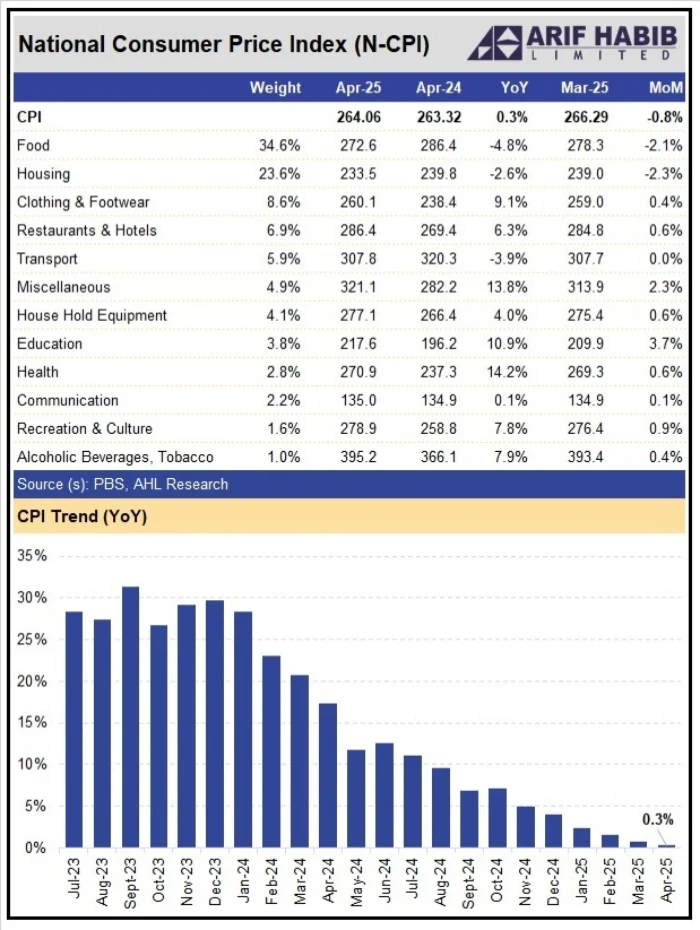
The disinflation was driven primarily by broad-based reductions in food and energy prices. On a month-on-month (MoM) basis, CPI fell by 0.8%, a notable reversal from the 0.9% increase seen in March.
Urban inflation dropped to 0.5% YoY, while rural inflation posted a negative reading of -0.1%. The month-on-month figures also reflected the downward trend, with urban CPI falling 0.7% and rural CPI declining by 1.0%.
Cumulatively, inflation for the first ten months of the fiscal year 2024–25 (July–April) stood at 4.73%, a sharp improvement from 25.97% during the same period in FY24. This substantial reduction highlights the effectiveness of the monetary and fiscal measures taken to stabilize prices and control economic volatility.
The Sensitive Price Indicator (SPI), a key measure for tracking essential commodities, showed further easing, with a 3.2% YoY drop, deepening from a 2.3% fall in March. On a monthly basis, the SPI dropped by 1.7%. Perishable food items led the decline, plunging 26.7% year-on-year.
Wheat prices dropped 36%, and onions witnessed an extraordinary 75% reduction. However, not all food items followed this trend — prices for pulse moong and butter surged by 29.8% and 24.5%, respectively.
Wholesale Price Index (WPI) inflation also registered relief, dropping 2.2% YoY in April versus a 1.6% fall in March. WPI declined 1.3% MoM after rising slightly by 0.3% in March.
Core inflation, which excludes volatile food and energy prices, eased to 7.4% in urban areas and 9.0% in rural regions, down from 8.2% and 10.2% in the previous month. However, on a monthly basis, urban core inflation rose 1.3%, and rural prices increased 0.9%, reflecting some underlying price pressures.
Among non-food categories, mixed trends were observed. Housing, water, electricity, gas, and fuel categories dropped 2.6% YoY, with electricity charges alone plummeting by 26.6%. Transport costs fell 3.9%, while education-related expenses rose by 10.9% annually.
The trimmed mean core inflation — which aims to capture long-term trends by excluding outliers — dropped to 3.8% in urban areas and 3.3% in rural areas on a yearly basis. MoM, it remained steady at 0.3% in urban zones and fell 0.1% in rural zones.
The April data signals a critical turning point for Pakistan’s economic outlook, suggesting easing inflationary pressures and improved price stability that may open the door for future monetary easing.
