

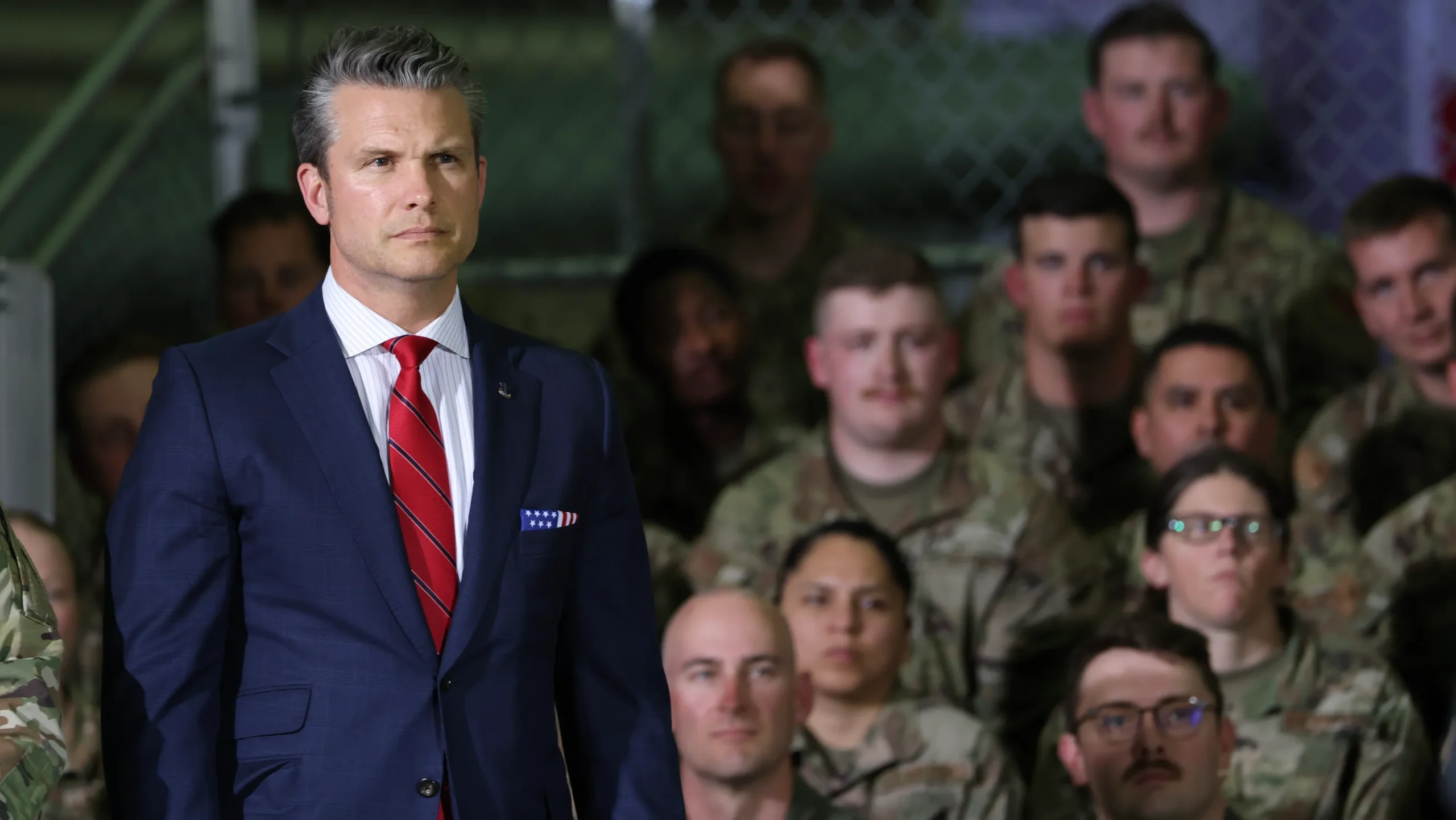

U.S. Defense Secretary Pete Hegseth announced a significant restructuring of the military’s leadership on Monday, ordering a 20% reduction in the number of four-star generals and admirals. The reform aims to streamline command structures and better align the armed forces with the strategic objectives of President Donald Trump’s second administration.
In a memo initially obtained by Reuters and later verified by the Pentagon, Hegseth outlined additional cuts: a 10% reduction in general and flag officers across the military branches, and a 20% reduction among general officers in the National Guard.
“This is not a slash-and-burn exercise meant to punish high-ranking officers,” Hegseth stated in a video posted on X (formerly Twitter). “This has been a deliberated process… with one goal: maximising strategic readiness and operational effectiveness.”
A former Fox News commentator and vocal critic of what he calls an over-inflated military leadership structure, Hegseth pointed to the disparity between general officers and enlisted personnel. He noted that in World War II, the ratio was one general for every 6,000 troops, compared to the current ratio of one for every 1,400.
Since assuming leadership of the Pentagon at the start of Trump’s second term, Hegseth has taken swift action to reshape the top levels of the military. Senior officials removed so far include General Charles Q. Brown, Chairman of the Joint Chiefs of Staff, Admiral Lisa Franchetti, Chief of Naval Operations, and the director of the National Security Agency.
Although the memo did not specify which positions will be cut, defense officials indicated that some of the military’s combatant commands could be consolidated. Proposed mergers include combining U.S. Africa Command with U.S. European Command and U.S. Southern Command with U.S. Northern Command—each of which could remove at least one four-star leadership position.
Currently, there are 38 active four-star generals and admirals in the U.S. military, including service chiefs and regional commanders responsible for key areas like U.S. Forces Korea and Pacific Army Command.
The reforms have sparked political backlash. Senator Jack Reed, the top Democrat on the Senate Armed Services Committee, criticized the move, warning that it risks harming military readiness without adequate analysis.
“Tough personnel decisions should be based on facts and analysis, not arbitrary percentages,” Reed said. “Eliminating positions held by some of our most experienced officers without clear justification could cripple—not strengthen—military effectiveness.”
The Pentagon has also experienced notable civilian shake-ups. Three senior aides, including Dan Caldwell and deputy chief of staff Darin Selnick, were dismissed amid a leak investigation. Both deny any wrongdoing.
These changes are part of a broader Trump administration initiative to reduce the size of the federal government and dismantle bureaucracies viewed as resistant to reform. Hegseth has also taken aim at the military’s diversity, equity, and inclusion programs, calling them “discriminatory.”
At his Senate confirmation hearing earlier this year, Hegseth remarked that larger staffs often correlate with less battlefield success—a sentiment that appears to drive his reform efforts. The Pentagon is now preparing to implement the leadership cuts “carefully but expeditiously,” according to defense officials.
While the long-term impact on U.S. global military operations remains unclear, insiders suggest the objective is not to scale back overseas commitments, but to create a more agile and efficient command structure.
