


Chancellor
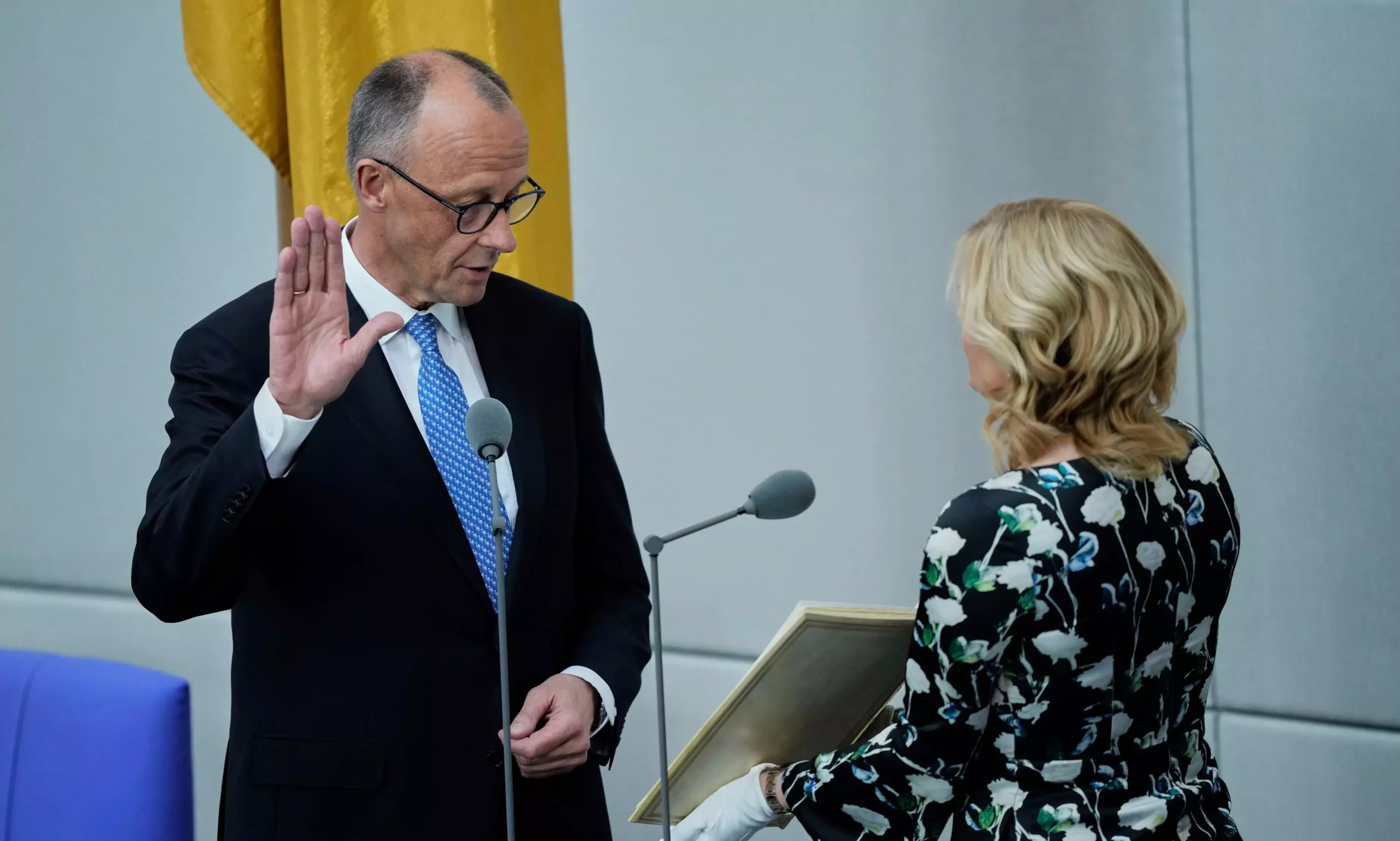
Germany’s conservative leader, Friedrich Merz, won a nail-biting second vote in parliament on Tuesday to become the country’s new chancellor, following an unexpected and stunning defeat in the first round of voting. Merz, 69, secured an absolute majority of 325 votes against 289 in the secret vote held in the Bundestag, the lower house of parliament.
His victory marks the culmination of a long-standing ambition to lead Germany, Europe’s largest economy, a goal that was first thwarted decades ago by his rival, former Chancellor Angela Merkel, who served for 16 years.
Merz now takes over at the helm of a coalition government formed between his Christian Democratic Union/Christian Social Union (CDU/CSU) alliance and the centre-left Social Democrats (SPD), who were led by outgoing Chancellor Olaf Scholz.
Shortly after the vote, President Frank-Walter Steinmeier was scheduled to formally appoint Merz as Germany’s 10th chancellor in the post-war era, along with his cabinet. Merz is also expected to visit Paris and Warsaw on Wednesday to begin his diplomatic engagements as the new leader of Germany.
However, Merz’s victory was bittersweet, as his initial defeat in the first round of voting was a shock to the political system. It was the first time in Germany’s post-war history that a candidate failed to secure an absolute majority in the first round.
The setback pointed to internal rifts within his coalition and sparked concerns about Merz’s ability to lead effectively. Political analyst Holger Schmieding of Berenberg Bank noted that the early loss “sowed doubts about his ability to fully pursue his agenda,” which could undermine his domestic and international authority in the short term.
The far-right Alternative for Germany (AfD) celebrated Merz’s initial defeat, with co-leader Alice Weidel suggesting that Merz should step aside and clear the way for a general election, calling the first-round result a “good day for Germany.”
Despite these early challenges, Merz pressed forward with his vision to revive Germany’s economy and restore its leadership role in Europe, particularly as the geopolitical landscape evolves under the leadership of U.S. President Donald Trump. Trump has put pressure on European allies, criticizing them for insufficient NATO spending and imposing tariffs that negatively affect Germany’s export-driven economy.
Before the second vote, CDU parliamentary leader Jens Spahn underscored the urgency of stabilizing the German government, given the mounting economic and geopolitical turbulence. “The whole of Europe, perhaps even the whole world, is watching this second round of voting,” Spahn remarked, urging lawmakers to take their responsibility seriously.
Merz, who has a strong business background but has never held a government leadership position, emphasized the profound changes and uncertainty facing Germany. He stated, “We live in times of profound change… and that is why we know it is our historic obligation to lead this coalition to success.”
Merz’s initial setback came when he failed to secure the required 316 votes in the first round, winning just 310 votes, with 307 votes against him. This underscored the challenge he faces in uniting his coalition, and analysts, such as Franziska Palmas of Capital Economics, cautioned that the early defeat “leaves Merz severely weakened,” suggesting that hopes for greater stability in German politics could be dashed.
Despite this, Merz’s perseverance in the second round demonstrated his ability to navigate through political adversity, though his leadership will likely continue to face scrutiny in the coming months.
