

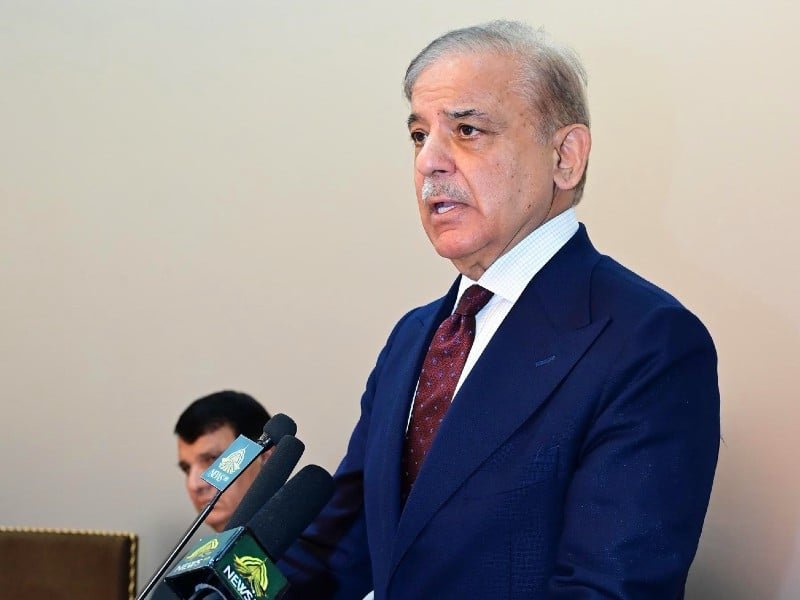

Prime Minister Shehbaz Sharif on Wednesday praised the Pakistan Armed Forces for their swift and forceful retaliation against India’s nighttime missile attack, calling it a transformation of “a dark night into a moonlit victory.”
Addressing the National Assembly amid rising tensions with India, the Prime Minister revealed that 27 Pakistani civilians, including children, were martyred in the unprovoked Indian strikes targeting six cities. “India launched its aggression under the cover of darkness, but with Allah’s help, our armed forces responded decisively. They turned the darkness into light,” he said.
Shehbaz confirmed that the Pakistan Air Force (PAF) downed five Indian fighter jets, including Rafale aircraft, and successfully struck military installations across the Line of Control (LoC). He commended Air Chief Zaheer Babar Sidhu for leading the operation, stating, “The illusion of Indian air superiority was shattered. Their jets never returned.”
The Indian strikes reportedly targeted areas including Azad Kashmir, Bahawalpur, Sheikhupura, and Sialkot. The Prime Minister stressed that Pakistan’s jets did not cross the border and carried out all defensive actions within Pakistani territory. “Those Rafales are no longer symbols of Indian pride—they’re now trophies of Pakistan,” he remarked.
Highlighting the impact of Pakistan’s retaliation, Shehbaz said the response not only rattled India but also boosted international confidence in Pakistan’s capabilities. “Last night, our enemies lost sleep while our allies’ trust deepened.”
He also mentioned attending a funeral in Islamabad for one of the martyrs alongside the President and Army Chief, honoring the fallen as national heroes. “They gave their lives to protect countless children. May Allah elevate their ranks,” he said.
Referring to India’s blame game over the Pahalgam attack in Occupied Kashmir, the Prime Minister condemned New Delhi’s attempt to implicate Pakistan without investigation. “India registered an FIR just minutes after the incident and started spinning narratives against us,” he stated, reiterating that Pakistan had no involvement and had offered to cooperate in an independent inquiry.
He further revealed that India was involved in a recent train hijacking incident in Balochistan and claimed Pakistan had undeniable evidence of Indian interference. He praised the Special Services Group (SSG) for saving civilian lives during the crisis.
Addressing Pakistan’s military preparedness, the Prime Minister stated that the armed forces had anticipated Indian aggression and were ready to respond. “India used 80 aircraft in the attack. Yet none of our planes crossed the LoC. We still shot down their jets with precision,” he said, adding that Indian forces had raised white flags at some points along the border.
He reiterated the significance of the military’s success, saying it restored public confidence and strengthened relations with Pakistan’s allies. Paying tribute to the fallen, he said, “They are the pride of our nation.”
In a notable moment, Shehbaz Sharif extended a hand of reconciliation to opposition parties, particularly Pakistan Tehreek-e-Insaf (PTI), urging them to set aside political rifts for national unity. “Let’s come together to build a greater Pakistan,” he appealed.
The Prime Minister ended his address with a strong call for solidarity. “Allah blessed Pakistan with a great victory last night. Now is the time to unite.” His remarks received rare support from the opposition benches, signaled through desk-thumping—a gesture of unusual parliamentary consensus.
