

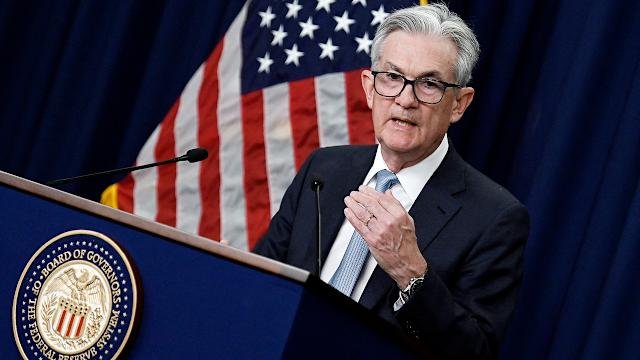

WASHINGTON — The Federal Reserve left interest rates unchanged on Wednesday, maintaining its benchmark rate at 4.25%–4.50%, while warning that the risks of both rising inflation and unemployment are growing—casting further doubt over the U.S. economic outlook.
Fed Chair Jerome Powell acknowledged the mounting uncertainty surrounding President Donald Trump’s evolving tariff policies, which have made it difficult for the central bank to chart a clear course forward. “The scope, scale, and persistence of those effects are very, very uncertain,” Powell said at a press conference following the Fed’s two-day policy meeting. “It’s not at all clear what the appropriate response for monetary policy is at this time.”
Powell’s comments reflected the central bank’s constrained position, as it awaits the full impact of Trump’s trade agenda. With major policy decisions still unfolding—and subject to legal and political pushback—the Fed signaled it would remain in a “wait-and-see” mode.
The Fed’s policy statement noted a rise in economic uncertainty since its March meeting, citing heightened risks that both inflation and joblessness could rise in the months ahead. While the central bank continues to point to a resilient labor market and steady growth, Powell admitted that recent data—including a first-quarter GDP dip influenced by a surge in pre-tariff imports—offered a murky picture of underlying demand and investment trends.
Economist Thomas Simons of Jefferies said the Fed’s language understated the recent volatility triggered by fluctuating tariff news, which has made business and consumer sentiment increasingly difficult to read. “It’s impossible to judge the economic outlook right now,” he noted, describing Powell’s cautious tone as “predictably noncommittal.”
While the Fed reaffirmed its dual mandate—maintaining stable inflation and maximum employment—Powell acknowledged that current trade tensions are delaying business decisions and potentially dampening demand. “If those concerns persist, they’ll show up in the data,” he said.
Still, the Fed made clear it won’t act until the direction of the economy becomes more evident. “Our current stance leaves us well positioned to respond in a timely way to potential economic developments,” Powell said.
Markets responded positively to the Fed’s decision: U.S. stocks closed higher, Treasury yields dipped, and the dollar edged up against other major currencies.
Looking ahead, the path of monetary policy will depend on which risk—rising unemployment or persistent inflation—ultimately materializes. The Fed may face a difficult choice if both increase simultaneously, potentially forcing a trade-off between supporting jobs and containing prices.
“For now, the Fed remains in a holding pattern,” said Ashish Shah, CIO of public investing at Goldman Sachs Asset Management. “The onus is on the labor market to soften enough to justify resuming rate cuts.”
Although Fed policymakers projected a half-point rate cut by the end of the year back in March, the economic picture has since become more complex amid trade uncertainty and global headwinds.
