

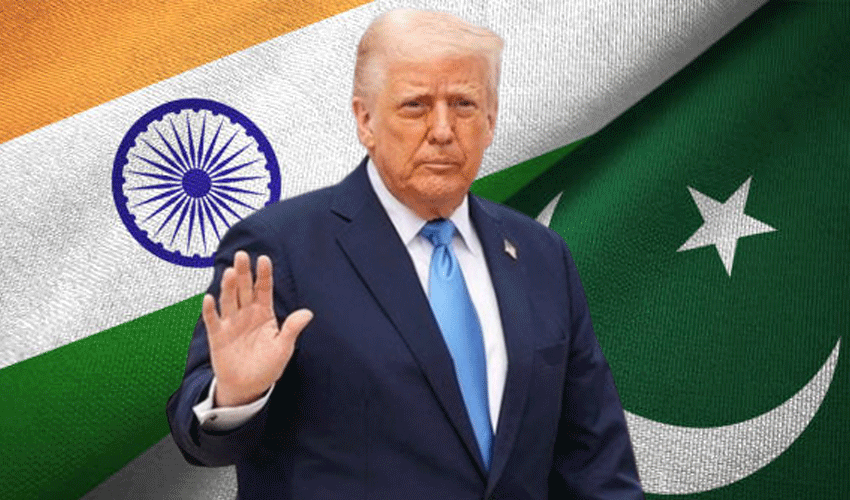

WASHINGTON/ISLAMABAD – U.S. President Donald Trump has called the recent ceasefire agreement between India and Pakistan a “historic and heroic” step, and signaled his intention to play a role in resolving the long-standing Kashmir dispute between the two nuclear-armed neighbors.
The ceasefire, announced following intense backchannel diplomacy led by Washington, brought a sudden halt to several days of high-intensity missile exchanges, drone incursions, and escalating rhetoric. Trump made the announcement late Friday on his social media platform, Truth Social, congratulating both Prime Ministers Narendra Modi and Shehbaz Sharif for “choosing common sense and great intelligence.”
“I am proud that the USA was able to help you arrive at this historic and heroic decision,” Trump said, referring to the ceasefire. “Additionally, I will work with you both to see if, after a ‘thousand years,’ a solution can be arrived at concerning Kashmir.”
Focus on Kashmir and Trade
President Trump’s remarks extended beyond the immediate cessation of hostilities. He hinted at a renewed diplomatic push to resolve the decades-old Kashmir conflict, calling it one of the most intractable disputes in modern geopolitics. While his mention of “a thousand years” was hyperbolic, it highlighted the chronic nature of the issue and his administration’s desire to place it firmly back on the international diplomatic agenda.
Trump also pledged to significantly enhance trade ties with both India and Pakistan, calling the two nations “great partners.” “I am going to increase trade, substantially, with both of these great Nations,” he wrote. Analysts view this as a potential economic incentive aimed at encouraging long-term stability and cooperation in South Asia.
Ceasefire Followed Heavy Cross-Border Strikes
The ceasefire announcement followed a week of heavy cross-border attacks that saw significant military losses on both sides. In retaliation for India’s missile strikes across the Line of Control, Pakistan launched Operation Bunyan-un-Marsus, a large-scale counteroffensive that reportedly targeted critical Indian military infrastructure.
Security sources in Islamabad confirmed that Pakistan deployed its newly-developed ‘Fatah 2’ ballistic missiles, striking multiple Indian airbases and missile storage sites. Targets reportedly included airfields in Udhampur, Adampur, Suratgarh, Sirsa, Bathinda, Akhnoor, Halwara, and Pathankot. The BrahMos missile storage site in Beas was said to have sustained substantial damage.
“These were calculated strikes targeting only military assets,” a senior Pakistani official told local media, underlining the strategic nature of the retaliation.
Diplomatic Push Behind the Scenes
According to CNN, Vice President JD Vance played a key role in coordinating the U.S. response, making a direct call to Prime Minister Modi to urge restraint. Secretary of State Marco Rubio and other senior officials reportedly worked through the night to facilitate communications between both sides.
While neither India nor Pakistan has officially released the terms of the ceasefire, diplomatic sources in Washington and Islamabad confirmed that the agreement was made possible through American mediation, with multiple countries, including China, Saudi Arabia, and Turkiye, also playing supportive roles.
A Fragile but Critical Moment
The ceasefire is being viewed as a rare diplomatic success in a region marked by repeated conflict. However, security analysts have warned that the situation remains fragile, with occasional skirmishes still being reported along the Line of Control.
Despite this, Trump’s vow to engage both countries on trade and peace-building, especially regarding Kashmir, marks a significant shift in U.S. engagement in South Asia. Whether this effort will yield tangible results remains to be seen, but for now, the region has stepped back from the brink.
