


1971 War
Prime Minister Shehbaz Sharif has hailed the success of Operation Bunyān-um-Marsoos as a historic achievement, declaring that Pakistan’s armed forces have avenged the 1971 war by delivering a powerful and decisive response to India’s recent aggression.
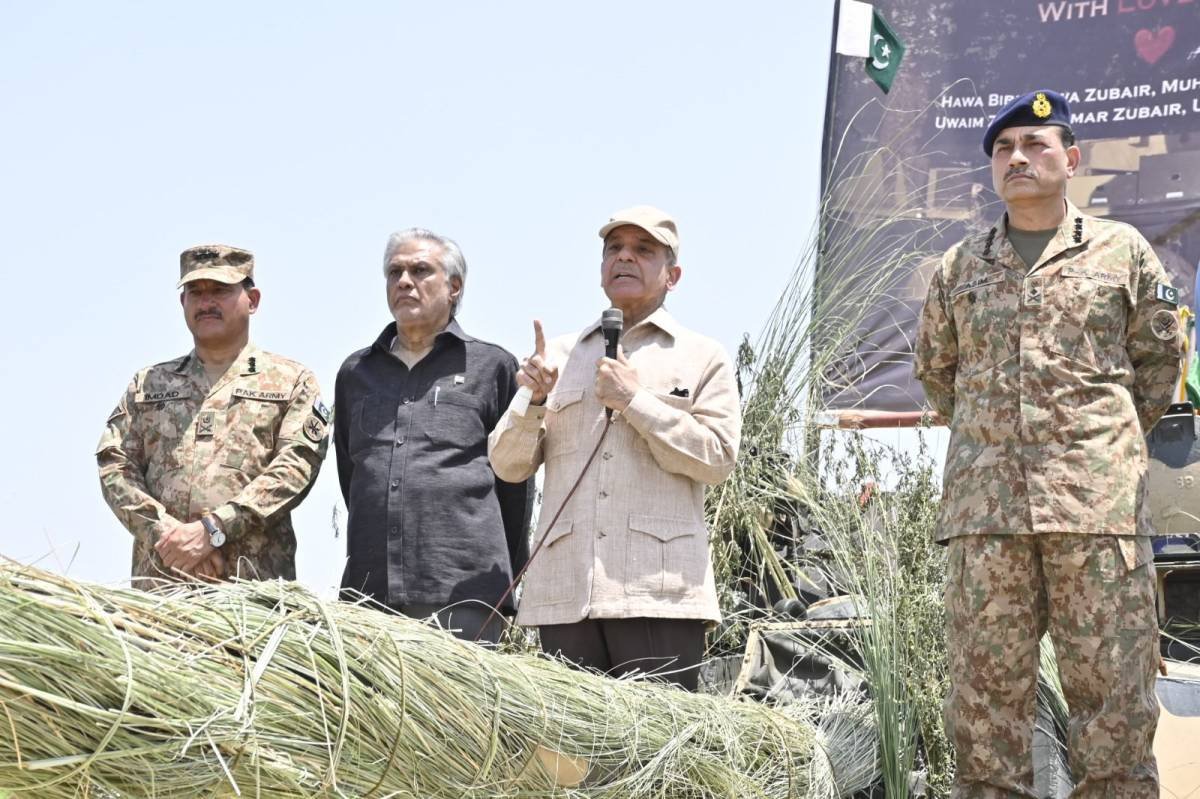
Speaking to soldiers deployed at the frontline in Pasrur Cantonment, near Sialkot, PM Shehbaz commended the valor and professionalism of the armed forces, describing their swift and coordinated actions as a moment that will be “eternally remembered in history.”
“Within a few hours, the defenders of Pakistan extinguished India’s unprovoked aggression with unmatched precision and unwavering resolve,” said the prime minister.
Accompanied by Deputy Prime Minister Ishaq Dar, Defence Minister Khawaja Asif, Planning Minister Ahsan Iqbal, and Information Minister Attaullah Tarar, PM Shehbaz was received by Chief of Army Staff (COAS) General Syed Asim Munir and Air Chief Marshal Zaheer Ahmed Baber Sidhu.
During the visit, military officials gave a detailed briefing on the conduct of the operation and the current state of operational preparedness. The prime minister paid tribute to the armed forces of Pakistan—army, navy, and air force—for their heroic performance. He emphasized that the recent conflict showcased the strength, unity, and discipline of the armed forces and shattered the illusion of India’s regional dominance.
Taking direct aim at Indian Prime Minister Narendra Modi, PM Shehbaz condemned New Delhi’s past support for the Mukti Bahini in 1971 and linked it to current efforts to destabilize Pakistan via support for groups like the BLA and TTP. “The world knows who trained the Mukti Bahini. The same nexus now backs those trying to disrupt Pakistan,” he said.
Shehbaz further issued a stern warning regarding the Indus Waters Treaty, cautioning India against any attempt to stop Pakistan’s water supply. “Water and blood cannot flow together. This is a red line,” he declared.
The premier also denounced India’s targeting of innocent civilians—including children, women, and the elderly—during its military operations, labeling it a clear violation of international law and morality.
He praised the high morale of the armed forces and assured them that the nation takes immense pride in their sacrifices. “Our martyrs are our pride, and their sacrifices will never be forgotten,” he said.
Addressing the broader context of the conflict, PM Shehbaz stated that while Pakistan remains committed to dialogue and regional peace, it will not accept a one-sided narrative. “We welcome peace but will respond with unmatched force to any future aggression,” he warned. He also responded to Modi’s recent speeches, saying, “Keep your fiery rhetoric to yourself. Do not mistake our desire for peace as weakness.”
Operation Bunyān-um-Marsoos was launched by Pakistan in response to India’s military strikes across the Line of Control (LoC) and within Pakistani territory—strikes which New Delhi claimed were aimed at so-called “terrorist targets.”
The conflict, which began following an attack in Indian-occupied Jammu and Kashmir that killed 26 tourists, lasted for 87 hours before a U.S.-brokered ceasefire agreement was reached on May 10.
According to the Inter-Services Public Relations (ISPR), Indian strikes resulted in the martyrdom of 53 Pakistanis—13 armed forces personnel and 40 civilians. Pakistan firmly rejected India’s claims of terrorist links and called for a neutral international investigation, which India refused.
PM Shehbaz’s remarks serve as a forceful reaffirmation of Pakistan’s military capability and its commitment to defending sovereignty while maintaining a principled stance for peace.
