

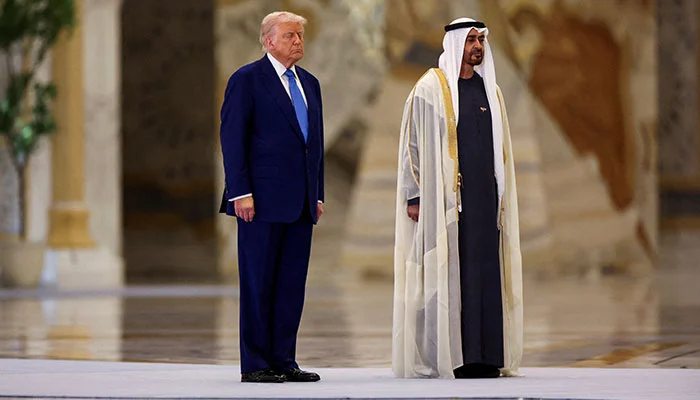

During his visit to the United Arab Emirates on Thursday, U.S. President Donald Trump announced agreements exceeding $200 billion, reinforcing bilateral economic and technological ties. The visit also marked a significant step toward deepening cooperation in the field of artificial intelligence.
Following his meeting with UAE President Sheikh Mohamed bin Zayed Al Nahyan, the White House confirmed a series of agreements, including a $14.5 billion commitment by Etihad Airways to acquire 28 Boeing 787 and 777x aircraft equipped with GE Aerospace engines.
In addition, the U.S. and UAE agreed to establish a joint framework called the “US-UAE AI Acceleration Partnership.” As part of this initiative, Trump and Sheikh Mohamed attended the unveiling of a 5GW AI campus, set to become the largest outside the United States.
Sources indicated the agreements will facilitate the UAE’s access to advanced U.S. AI chips—technology previously restricted due to concerns that it could be transferred to China.
Trump’s UAE visit followed a stop in Qatar, where he praised Doha’s pledge to invest $10 billion in a U.S. military facility. In a meeting with Sheikh Mohamed, Trump emphasized the strength of U.S.-UAE ties and referenced a $1.4 trillion investment commitment the UAE intends to make in the U.S. over the next decade, a pledge earlier conveyed by Sheikh Tahnoon bin Zayed Al Nahyan, the UAE’s national security adviser.
At Abu Dhabi airport, Trump was welcomed by Sheikh Mohamed. The two leaders visited the Sheikh Zayed Grand Mosque, which had been closed to the public for the day in honor of the U.S. president. Trump described the mosque as “so beautiful” and said its closure was a tribute to the United States.
According to a White House factsheet, the new agreements include a $4 billion investment by Emirates Global Aluminum to develop a primary aluminum smelter in Oklahoma, and a $60 billion partnership between ExxonMobil, Occidental Petroleum, EOG Resources, and the Abu Dhabi National Oil Company to boost oil and gas production.
Sheikh Mohamed affirmed the UAE’s commitment to strengthening its relationship with the United States, calling Trump’s visit a testament to mutual interest and cooperation.
Before departing for the UAE, Trump addressed U.S. troops at Al Udeid Air Base near Doha, revealing that Qatar had signed $42 billion in defense agreements with the U.S.
The UAE is actively seeking American support to become a global hub for artificial intelligence. The two countries have reached a preliminary deal allowing the UAE to import 500,000 of Nvidia’s cutting-edge AI chips annually, beginning this year. This would aid the UAE’s plans to develop large-scale data centers critical for AI advancement.
The agreement also commits the UAE to build or finance U.S.-based data centers of equal scale and strength as those in the Emirates. It includes provisions to align the UAE’s national security regulations with those of the U.S., ensuring stringent safeguards against the diversion of sensitive U.S. technology.
Under the previous U.S. administration, led by Joe Biden, the export of AI chips to the Middle East had been closely regulated due to fears that the technology might end up enhancing China’s military capabilities.
At the UAE presidential palace, Trump and Sheikh Mohamed were seen conversing with Nvidia CEO Jensen Huang, further underlining the central role of AI in the bilateral agenda.
Trump noted he may return to Washington on Friday, though he suggested he could stop in Istanbul for discussions on Ukraine. His visit to the Gulf region began on Tuesday and included a series of high-profile economic and diplomatic engagements.
Other major deals during Trump’s Gulf tour included Qatar Airways’ plan to purchase up to 210 Boeing widebody jets, Saudi Arabia’s pledge to invest $600 billion in the U.S., and $142 billion in American arms sales to the kingdom.
In Qatar, Trump also indicated progress toward a new nuclear agreement with Iran, stating that Tehran had “sort of” accepted the terms. Additionally, he announced the removal of longstanding U.S. sanctions on Syria and met with Syrian interim President Ahmed al-Sharaa, encouraging the country to normalize relations with Israel.
Trump has made enhancing relationships with Gulf nations a focal point of his foreign policy. Should the AI chip deals materialize, the Gulf region—especially the UAE—could emerge as a third major hub in the global AI race, alongside the U.S. and China.
