

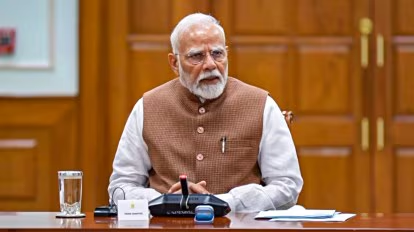

Indian Prime Minister Narendra Modi escalated his rhetoric against Pakistan on Thursday, declaring that Pakistan would not receive water from rivers over which India holds rights. His remarks come in the wake of the deadly April 22 attack in Indian Illegally Occupied Jammu and Kashmir (IIOJK), which led New Delhi to suspend the Indus Waters Treaty (IWT).
Speaking at a public event in Rajasthan, a state bordering Pakistan, Modi warned: “Pakistan will pay a heavy price for every terrorist attack — its army and economy will bear the cost.” The statement was part of a broader response to the April incident, which left 26 people dead, most of them Hindu pilgrims. India blamed Pakistan for the attack without publicly presenting evidence.
Following the incident, India carried out missile strikes on Pakistani cities, igniting the most intense military confrontation between the two nations in nearly three decades. A ceasefire agreement was reached on May 10.
The Indus Waters Treaty, brokered by the World Bank in 1960, allows Pakistan access to vital irrigation water from three rivers originating in India. These rivers support 80% of Pakistan’s agricultural sector. However, Pakistan’s finance minister stated earlier this month that the suspension of the treaty would not have an immediate impact.
Indian Foreign Minister Subrahmanyam Jaishankar also reinforced the threat of continued military operations, stating that the current ceasefire is holding, but India remains poised to retaliate if similar attacks recur. “If terrorists are in Pakistan, we will strike them where they are,” Jaishankar told Dutch outlet NOS, adding that Indian forces have repositioned accordingly.
Tensions between the two nuclear-armed neighbours remain high, with both sides enacting punitive measures. These include the suspension of trade, closure of land crossings, and a near-total halt to visa issuance.
There has been no official response from Pakistan to the recent comments made by Modi and Jaishankar.
