

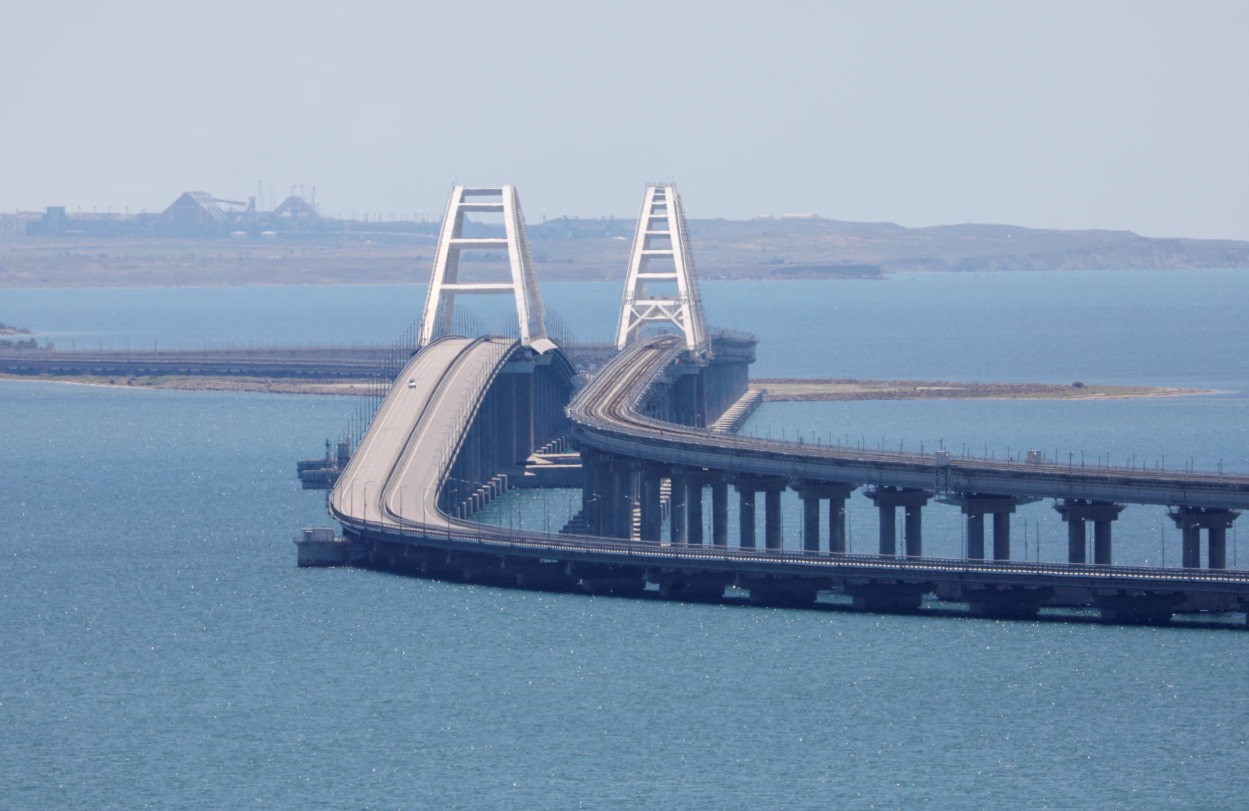

Ukraine’s Security Service (SBU) announced on Tuesday that it had successfully targeted the Kerch Bridge—linking Russia to Crimea—using underwater explosives in a covert operation aimed at disrupting Russian supply lines.
According to the SBU, the special operation involved placing 1,100 kilograms (approximately 2,420 pounds) of explosives beneath the bridge, resulting in significant damage to its underwater support structures. The blast reportedly took place in the early morning hours and directly impacted the structural integrity of the bridge, which has long served as a crucial logistical route for Russian military operations in occupied Ukrainian territory.
Photos released by Ukrainian officials show damage to parts of the bridge, including its underwater pillars. These visuals support Kyiv’s claim of an underwater detonation, a tactic that signals a shift in Ukraine’s military strategy by targeting key Russian infrastructure from below the surface.
Russian authorities confirmed a temporary disruption in the bridge’s operation, stating that traffic was halted from approximately 4 a.m. to 7 a.m. local time. The bridge was later reopened following an assessment by Russian engineers, who deemed it safe for use. However, no details were provided regarding the extent of the structural damage or the timeline for full restoration.
While Moscow has yet to officially comment on Ukraine’s specific claims about underwater explosives, the incident has once again drawn international attention to the vulnerability of Russian infrastructure in Crimea—a region annexed by Russia in 2014 and still widely recognized as Ukrainian territory by the international community.
This is not the first time the Kerch Bridge has been targeted. Previous attacks have temporarily disabled or disrupted its operations, making it a consistent focal point in the ongoing conflict between Ukraine and Russia.
Ukraine’s use of unconventional warfare methods highlights the evolving dynamics of the conflict, where critical infrastructure has increasingly become a central target in efforts to disrupt enemy logistics and exert pressure on occupying forces.
